
TURTLE POND & BELVEDERE
Location
Geographic Setting
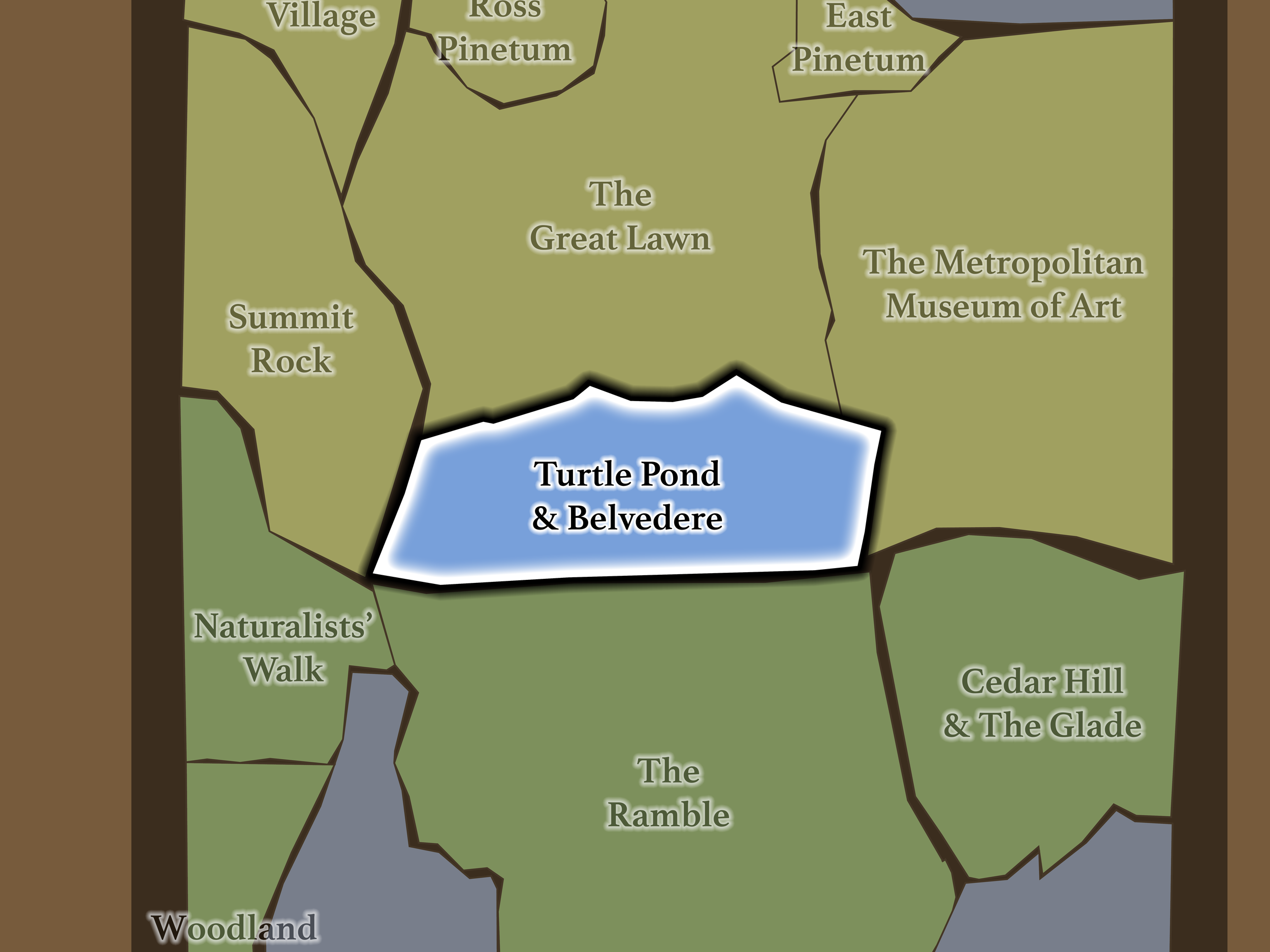
Turtle Pond & Belvedere occupies an unusually compact but topographically complex landscape at the southern edge of Mid-Park. Summit Rock lies across West Drive; The Great Lawn opens immediately north of Turtle Pond; The Metropolitan Museum of Art lies across East Drive; and The Ramble begins beyond the 79th Street Transverse to the south.
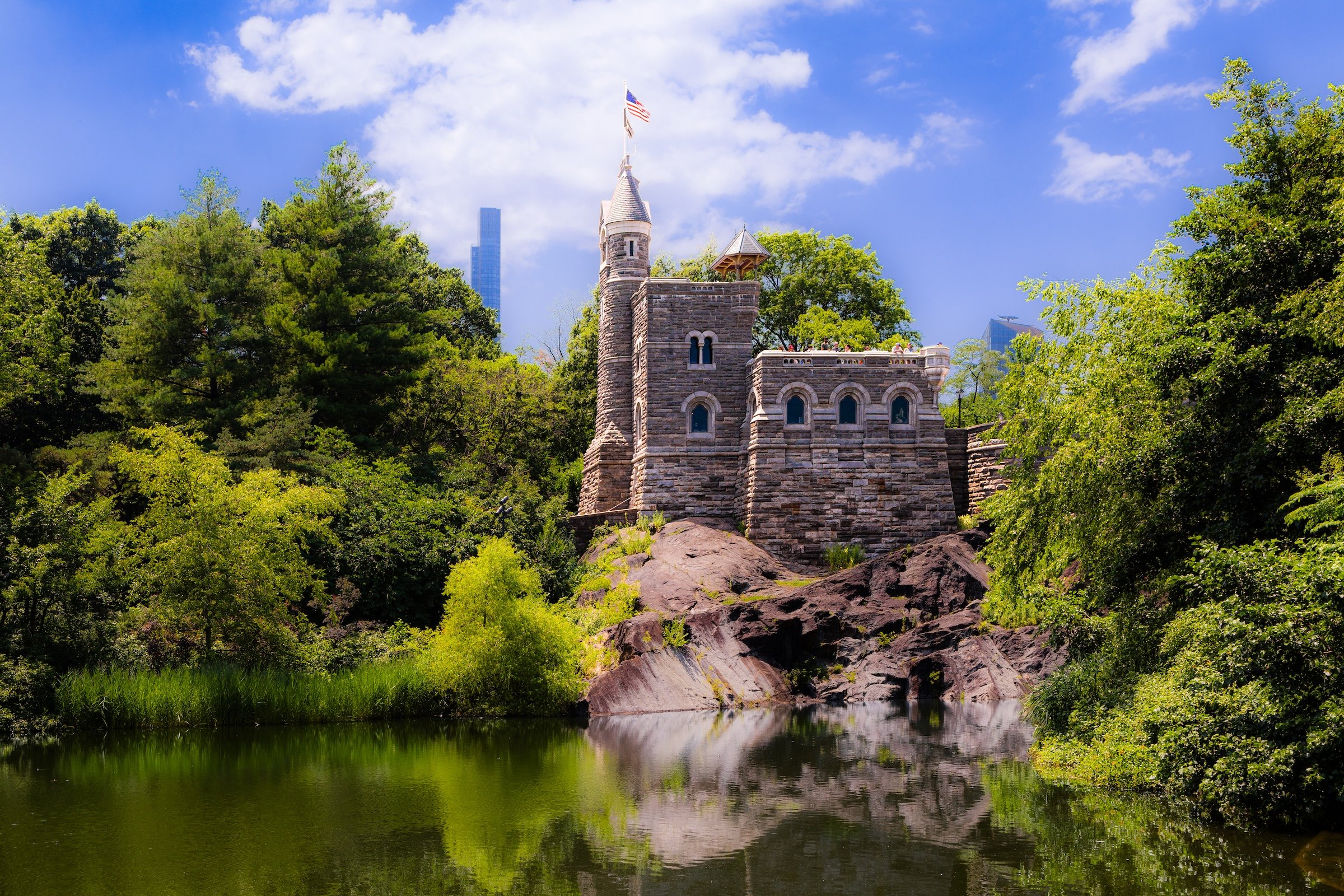
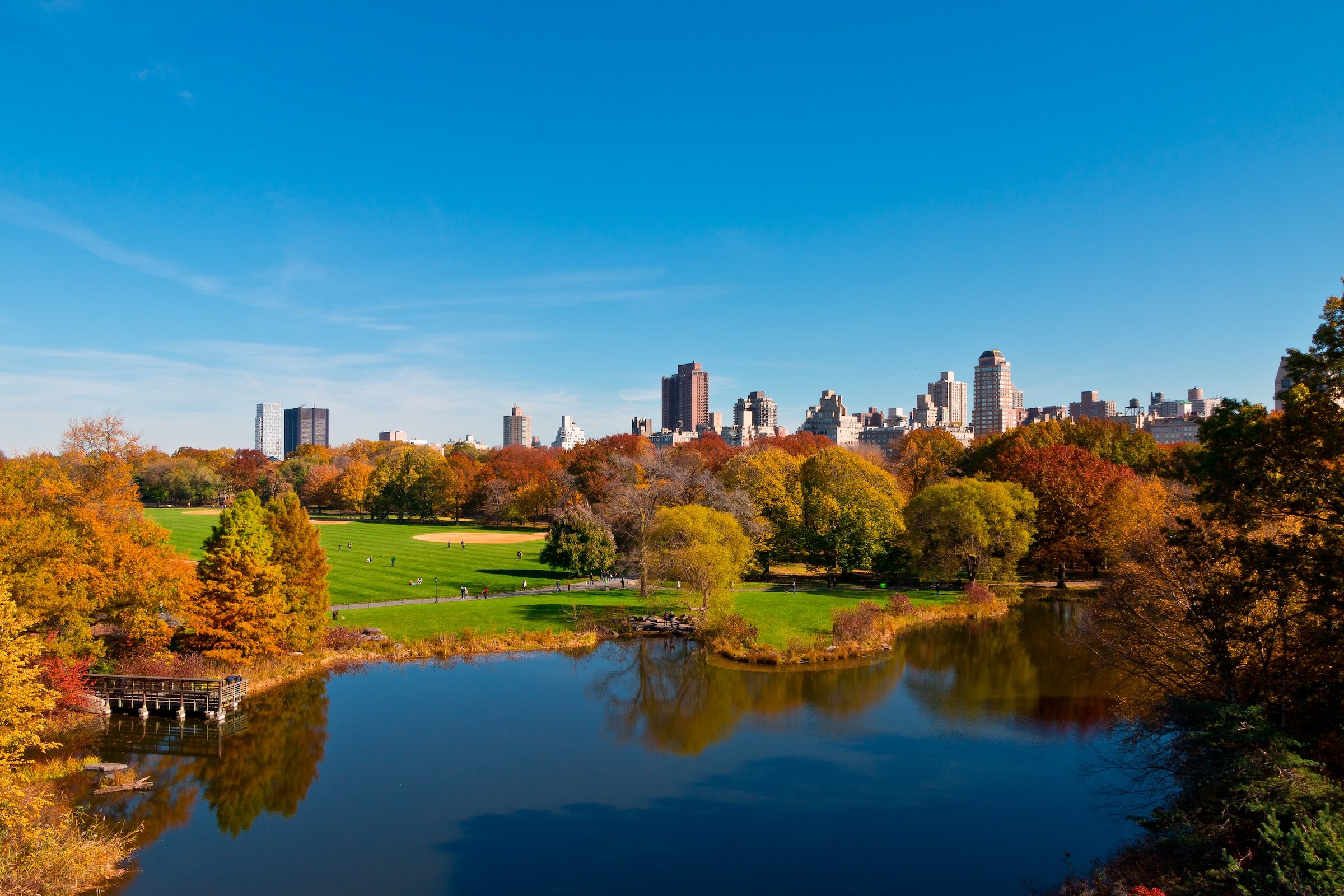
At its center rises Vista Rock, approximately 130 feet above sea level and the second-highest natural point in Central Park. The 79th Street Transverse passes directly through the massive outcrop in a tunnel blasted through the rock, while Belvedere Castle rises from its summit. Turtle Pond spreads below to the north, creating one of Central Park’s most recognizable compositions.
Yet this neighborhood is much more densely packed than that famous view suggests. Within a short walk are a castle, pond, theater, formal garden, historic cottage, monumental sculpture and some of the park’s most dramatic elevation changes.
Etymology
Turtle Pond & Belvedere joins the two features that visually and experientially anchor this densely layered part of Mid-Park.
Belvedere comes from the Italian for “beautiful view,” an apt name for Olmsted and Vaux’s picturesque overlook atop Vista Rock. Turtle Pond received its present name in 1987 in recognition of the turtles that inhabit the two-acre water body; before then, the pond created in 1937 was generally known as Belvedere Lake.
Together they describe the neighborhood’s defining composition: water below, rock and castle above.
History
1858–1873: Greensward Plan & Construction
The essential landform was already here when Olmsted and Vaux began designing Central Park.
Vista Rock presented both an opportunity and an obstacle. Its commanding elevation made it a natural overlook, while its enormous mass complicated the designers’ circulation plans. Engineers blasted the 79th Street Transverse directly through the rock, allowing crosstown traffic to disappear beneath the park landscape.
Immediately to the north stood the old Croton Receiving Reservoir, which predated Central Park and occupied the land now containing the Great Lawn and Turtle Pond. The southern edge of that enormous utilitarian structure met the elevated landscape of Vista Rock, creating a difficult transition between infrastructure and scenery.
Olmsted and Vaux eventually turned that transition into spectacle. In 1866, they designed a terrace and whimsical open-air structure atop the rock from which visitors could look north across the reservoir and south across the Ramble. Construction of the Belvedere began the following year.
1858–1899: Early History & Grand Openings
When Belvedere opened in the early 1870s, it was not intended to be a conventional building. It was a folly—architecture created principally for visual pleasure and to provide a destination from which visitors could survey the surrounding landscape.
Its placement was carefully theatrical. Seen from elsewhere in the park, the miniature castle drew visitors toward Vista Rock; once they reached it, the reward was the panorama beyond. Built largely from Manhattan schist excavated during park construction, the structure appears almost to grow directly from its rocky foundation.
The neighborhood gained another remarkably unusual building after the 1876 Centennial Exhibition in Philadelphia. A wooden Swedish schoolhouse exhibited there was brought to Central Park and became the Swedish Cottage. It subsequently served as a tool house, restroom, laboratory and other park functions before eventually becoming associated with marionette theater.
20th Century: Transformation & Restoration
The twentieth century transformed nearly every part of this neighborhood.
After the old Receiving Reservoir was drained and filled, the Great Lawn was constructed in the 1930s and Turtle Pond was created in 1937 along its southern edge. The new water body restored water to the view below Belvedere, but in a far smaller and more naturalistic form than the reservoir it replaced.
Meanwhile, Shakespeare Garden had begun in 1912 as the “Garden of the Heart,” created by Parks entomologist Edmond Bronk Southwick as a place where schoolchildren could study plants and natural history. It later evolved into a garden featuring flowers and herbs mentioned in Shakespeare’s writings.
Belvedere itself became functional for the first time in 1919, when the U.S. Weather Bureau enclosed the formerly open-air folly and established a weather station there. After the staff departed in the early 1960s, the Castle deteriorated badly until the newly formed Central Park Conservancy restored it and reopened it as a visitor center in 1983.
The neighborhood also became one of Central Park’s great cultural centers. Joseph Papp began presenting free Shakespeare nearby in 1957, and the permanent Delacorte Theater opened in 1962 with The Merchant of Venice.
The monumental King Jagiello arrived earlier, in 1945. Stanisław Ostrowski had created the equestrian sculpture for the Polish Pavilion at the 1939 World’s Fair, but the Nazi invasion prevented its return to Poland. It was ultimately given a permanent home overlooking Turtle Pond.
Explore
21st Century: Renovation & Modernization
Turtle Pond & Belvedere is perhaps Mid-Park’s richest concentration of experiences.
The classic approach is visual: Turtle Pond in the foreground, Vista Rock rising behind it and Belvedere Castle emerging above the trees. It is the perspective from which countless photographs of this part of Central Park begin.
But the neighborhood rewards moving through it rather than simply photographing it.
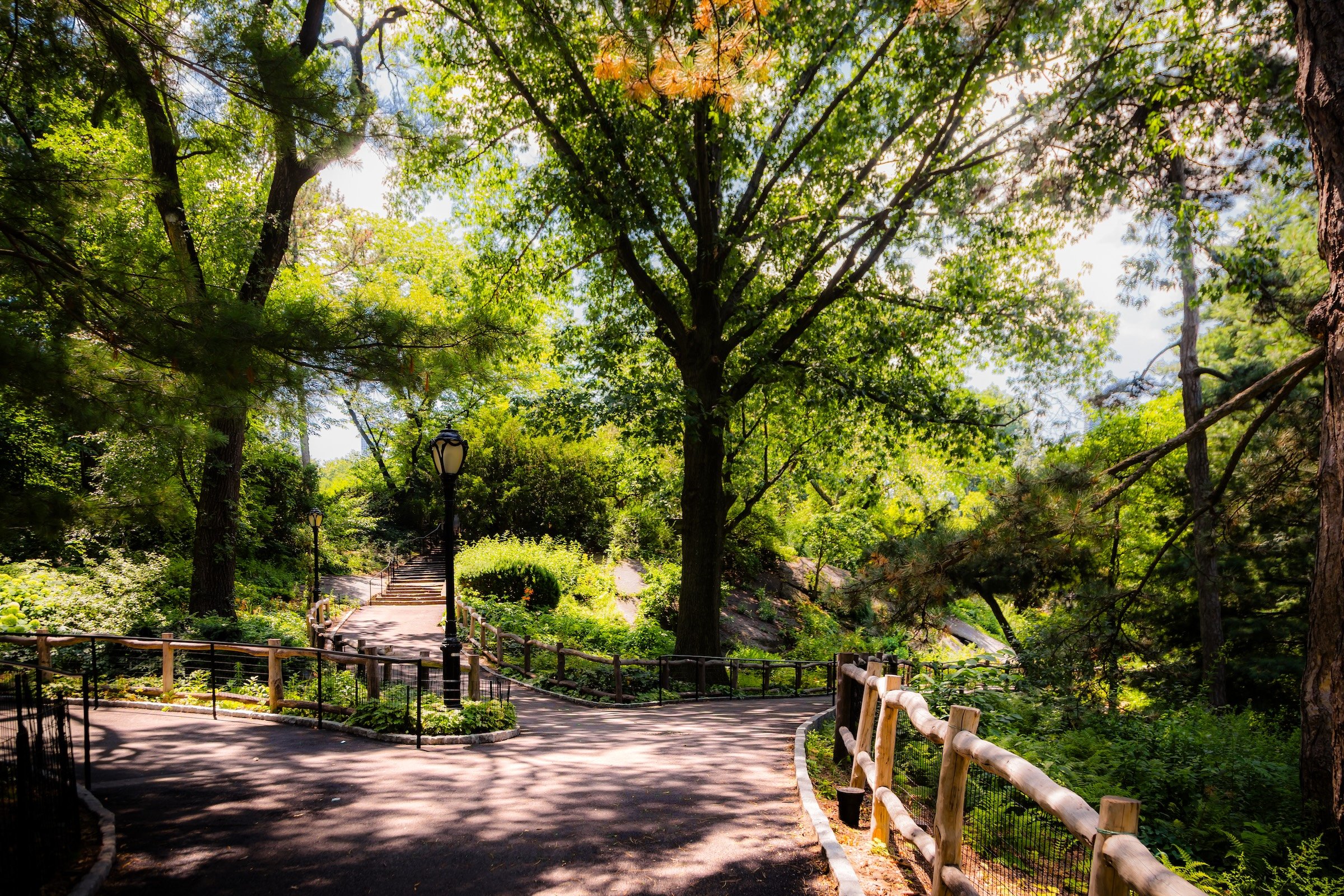
Paths climb Vista Rock toward Belvedere’s terraces, where the view opens north across Turtle Pond and the Great Lawn and south toward the Ramble. Shakespeare Garden turns the western slope into a more intimate succession of flowers, herbs, rustic steps and secluded corners. The Swedish Cottage adds another unexpected architectural layer, while the Delacorte makes this one of Central Park’s most important civic gathering places.
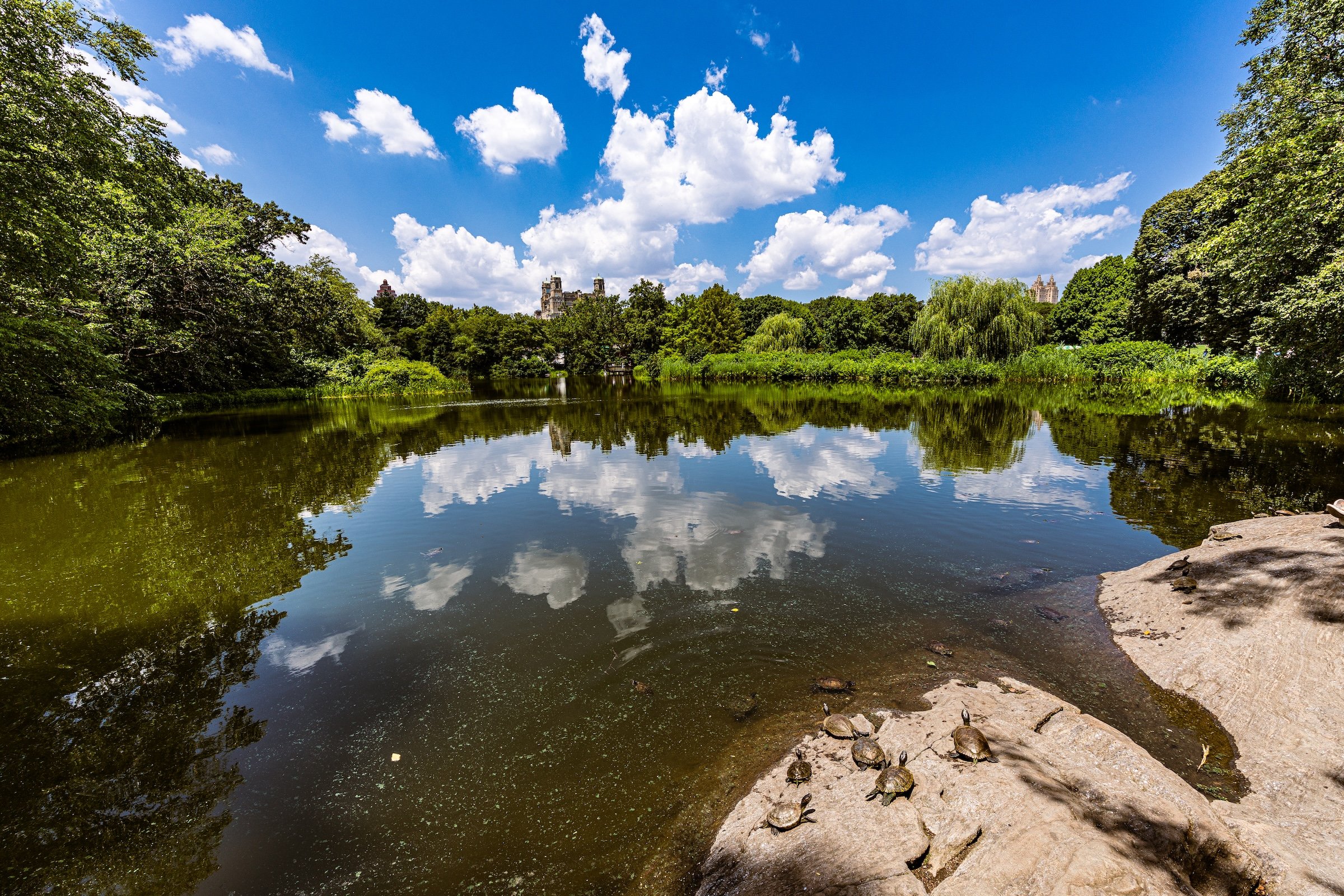
Turtle Pond itself was substantially naturalized during the Great Lawn restoration of the 1990s. The Conservancy dredged the pond, rebuilt its shoreline with boulders and wetland plantings, created wildlife habitat and added viewing areas. Today five turtle species live there year-round.
The neighborhood has also just completed another significant cycle of renewal. Belvedere Castle underwent a comprehensive restoration completed in 2019. The Delacorte Theater reopened in August 2025 after its first major reconstruction in more than six decades, with improved accessibility and sustainability, while restoration of Shakespeare Garden was completed in spring 2026.
Few places in Central Park compress so much into such a small area: geology, water, architecture, wildlife, horticulture, sculpture, theater and panoramic views all overlap here.
Waypoints
-
Designed as a whimsical open-air lookout rather than a functional castle, Belvedere offers some of Central Park’s broadest views. Its terraces look across Turtle Pond and the Great Lawn, while weather observations have been associated with the site since 1919.
-
Opened in 1962 as the permanent home of Joseph Papp’s free Shakespeare performances, the Delacorte continues The Public Theater’s tradition of Free Shakespeare in the Park. A major reconstruction was completed in 2025, creating a more accessible and sustainable theater while preserving free performance at its core.
-
Stanisław Ostrowski’s monumental equestrian sculpture depicts the Polish king and Lithuanian grand duke raising the two swords associated with the 1410 Battle of Grunwald. Created for the 1939 World’s Fair, it was installed beside Turtle Pond in 1945 after World War II prevented its return to Poland.
-
Milton Hebald’s bronze sculpture of Shakespeare’s lovers was installed outside the Delacorte in 1977, twenty years after Romeo and Juliet became the first play Joseph Papp presented in Central Park.
-
Originally established in 1912, this four-acre hillside garden contains flowers, herbs and other plants associated with Shakespeare’s works, accompanied by plaques bearing passages from his writing. Its winding paths and secluded spaces make it one of Mid-Park’s most contemplative landscapes
-
Built in Sweden and displayed at Philadelphia’s 1876 Centennial Exhibition, this picturesque wooden building was later moved to Central Park. After serving numerous park functions, it became home to the Swedish Cottage Marionette Theatre.
-
Also created by Milton Hebald and installed in 1977, the sculpture depicts Prospero and Miranda and forms a companion to Romeo & Juliet outside the theater.
-
Created in 1937 following the removal of the old Receiving Reservoir, this two-acre pond is now home to several species of turtles and provides the classic water-level view toward Vista Rock and Belvedere Castle.
-
Rising approximately 130 feet above sea level, Vista Rock is Central Park’s second-highest natural point. Its elevation inspired Olmsted and Vaux to place Belvedere atop it, while the 79th Street Transverse was blasted through the rock below.
Photography
Visual Identity
Central Park has no single visual identity. It moves between open meadow and enclosed woodland, exposed bedrock and carefully planted garden, reflective water and hard-edged skyline. Its paths can narrow into shade beneath old trees, then open suddenly toward towers, lakes, monuments, or a broad field filled with people. The Park’s character is made from those transitions: the designed discovery of one landscape giving way to another.
Water and horizon recur throughout its geography. The Lake, Reservoir, ponds, fountains, and seasonal pools of light create places of reflection—sometimes literal, sometimes figurative—where the city appears fractured, softened, or enlarged. Beyond them, Manhattan’s towers remain present as a constant reminder that this cultivated landscape exists within, not apart from, one of the world’s densest cities.
Its visual language also changes dramatically with the seasons. Winter exposes branches, stone, and skyline; spring briefly turns the Park into blossom and color; summer fills its lawns and paths with activity; autumn intensifies the drama of canopy, water, and light. Central Park is designed to be revisited, and its identity is never fixed for long.