
CHERRY HILL & CONCOURSE
Location
Geographic Setting
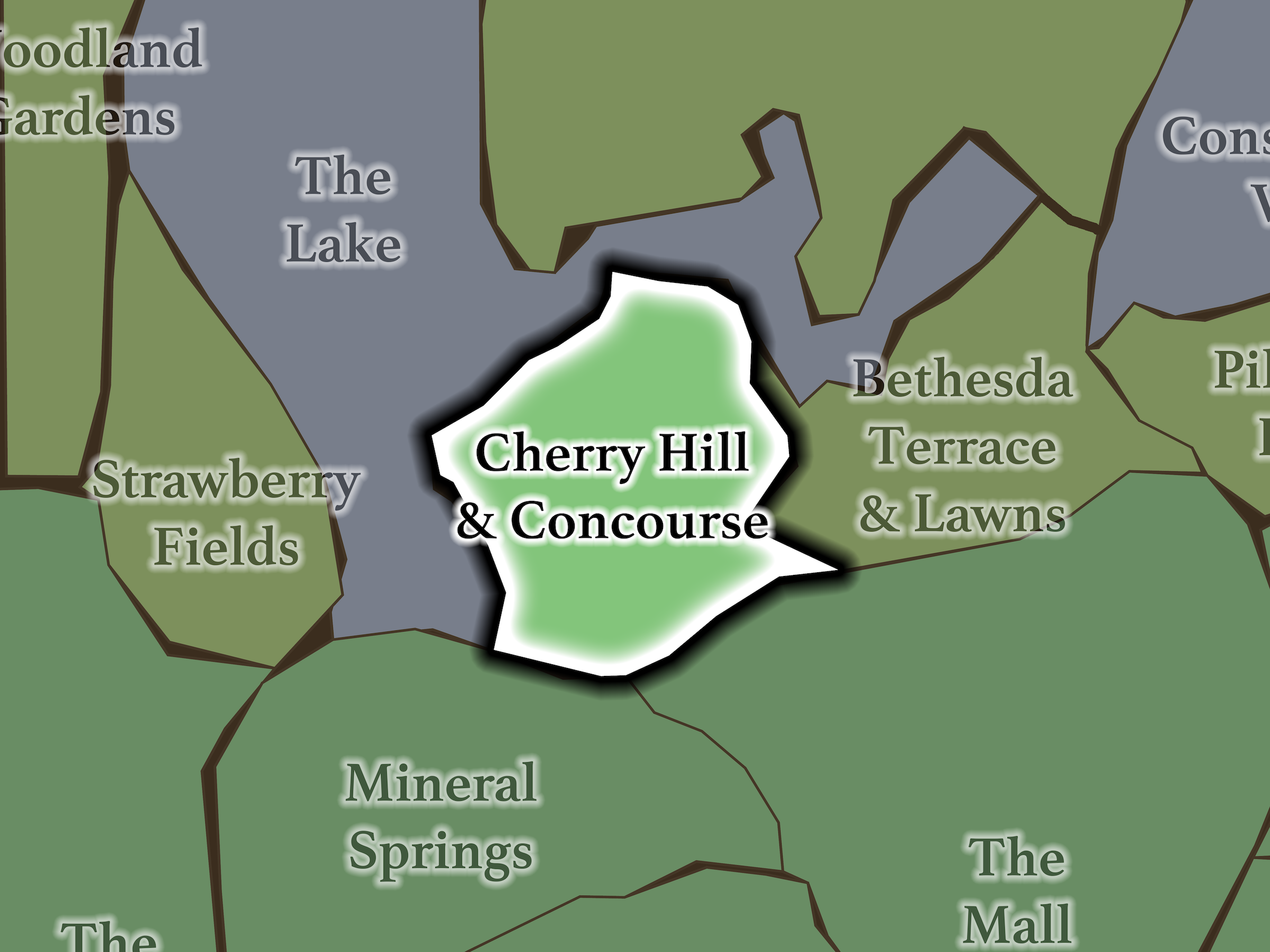
Cherry Hill & Concourse occupies the southern shoreline of The Lake in Mid-Park South. The Lake surrounds it to the west and north; Bethesda Terrace & Lawns lies immediately east; and The Mall and Mineral Springs begin beyond Terrace Drive to the south.
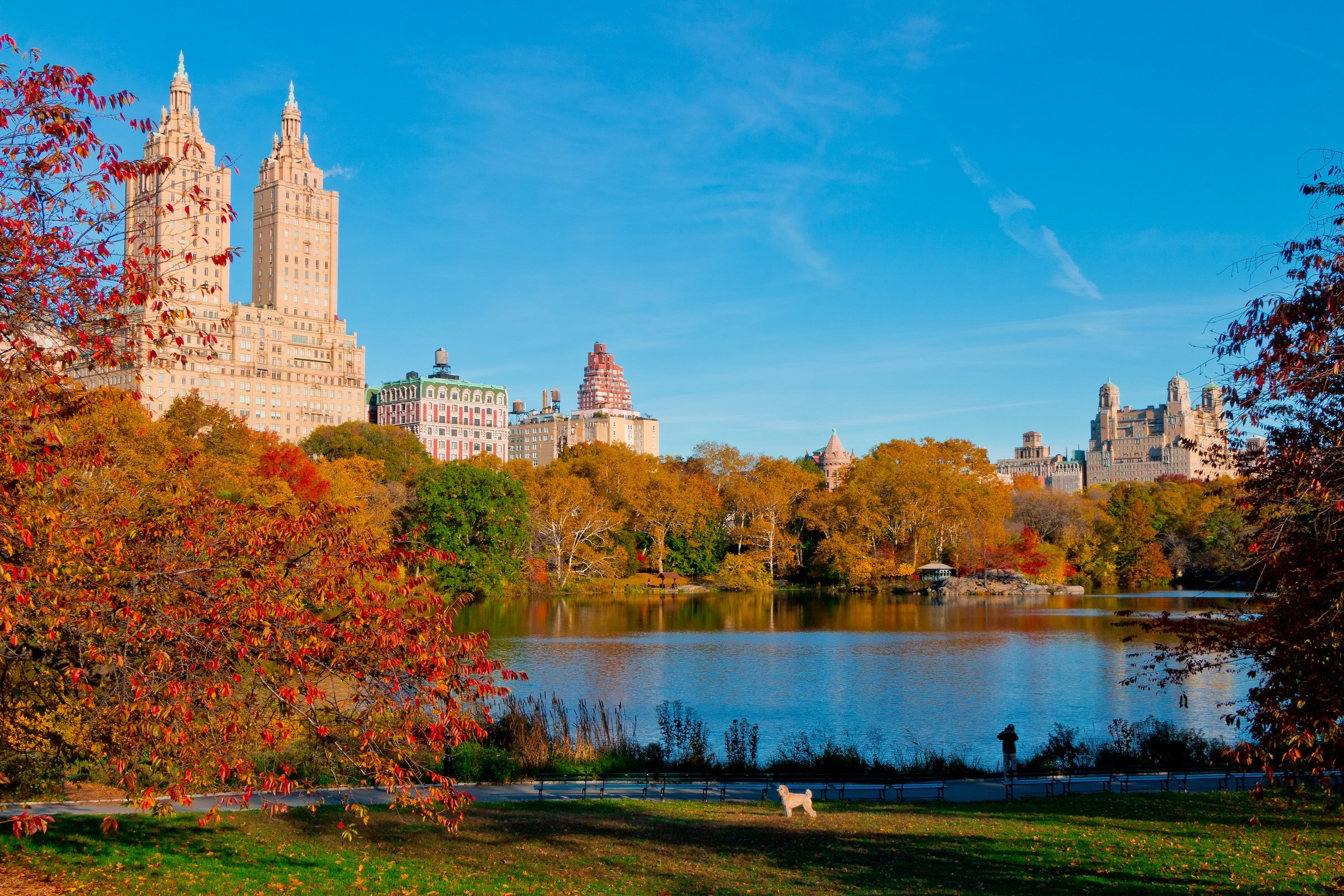
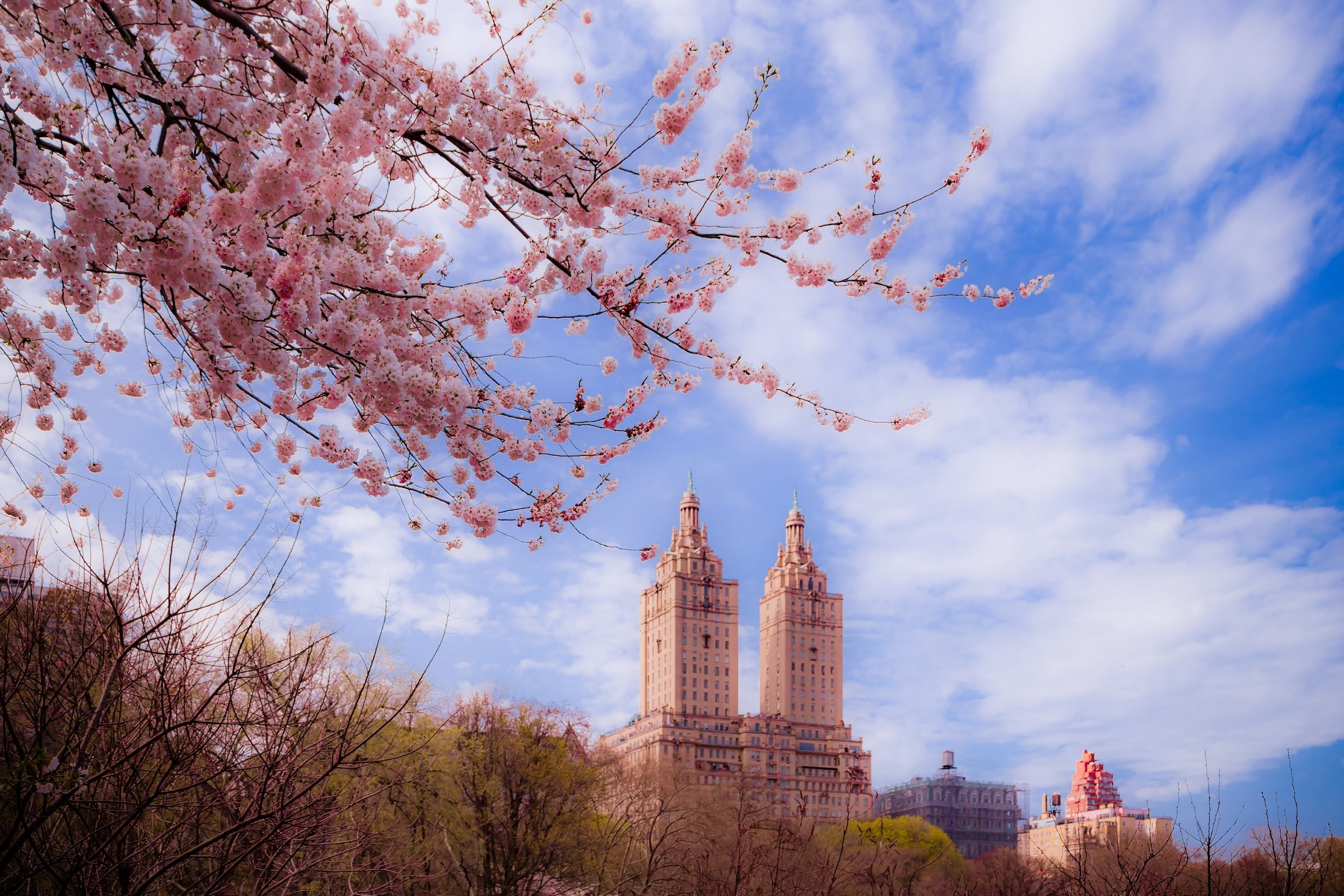
The landscape rises from the Lake shoreline to the broad circular Concourse at its summit. That elevation produces some of Central Park’s great panoramic compositions: the Lake below, Bow Bridge stretching toward the Ramble, and the apartment towers of Central Park West rising above the trees beyond.
The hill itself is more intimate. Sloping lawns, rock, winding paths and flowering trees create places to sit beneath the canopy or descend toward the water, while Wagner Cove occupies a secluded indentation along the southern Lake edge.
Etymology
Cherry Hill & Concourse joins the name of the landscape with the formal carriage turnaround at its summit.
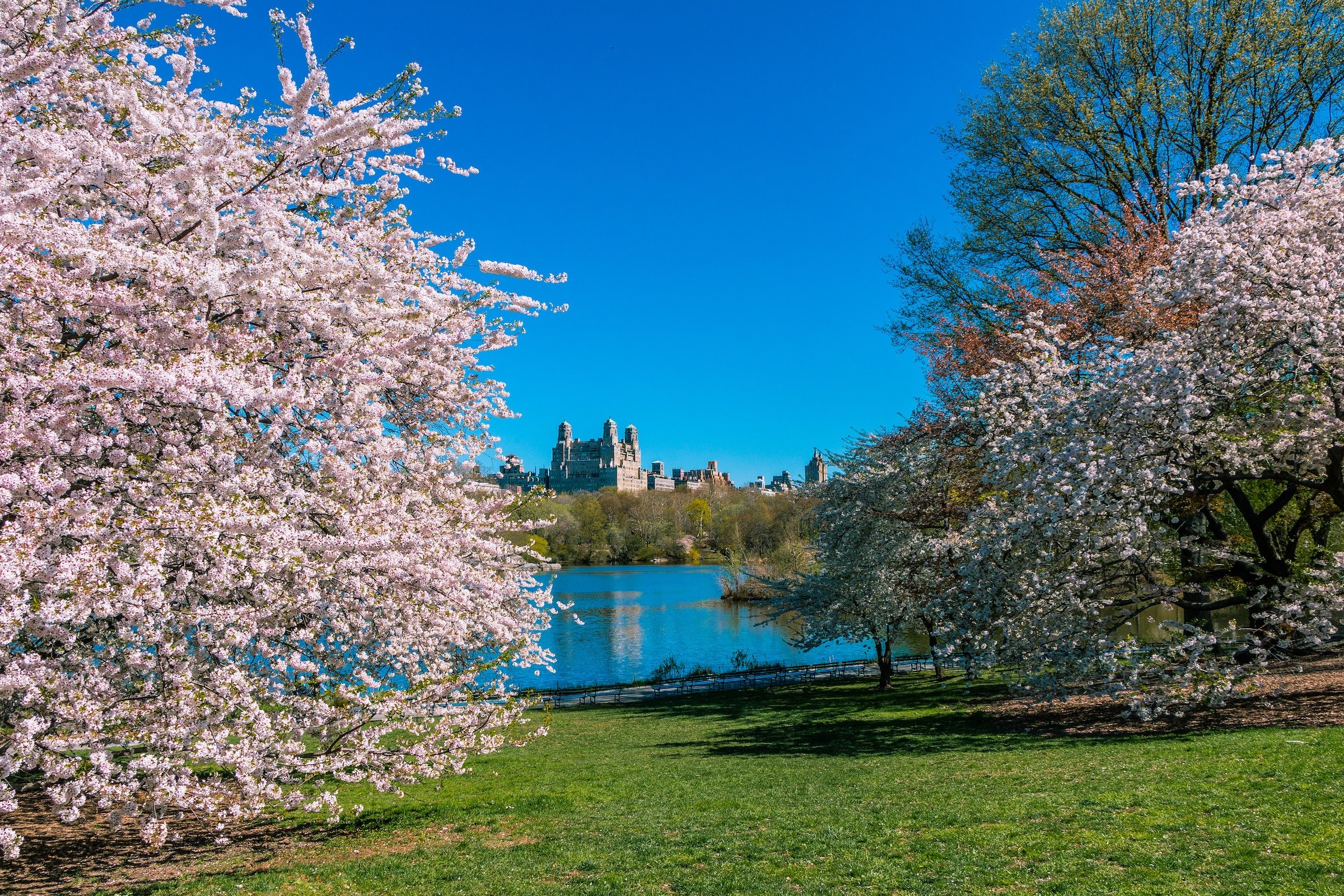
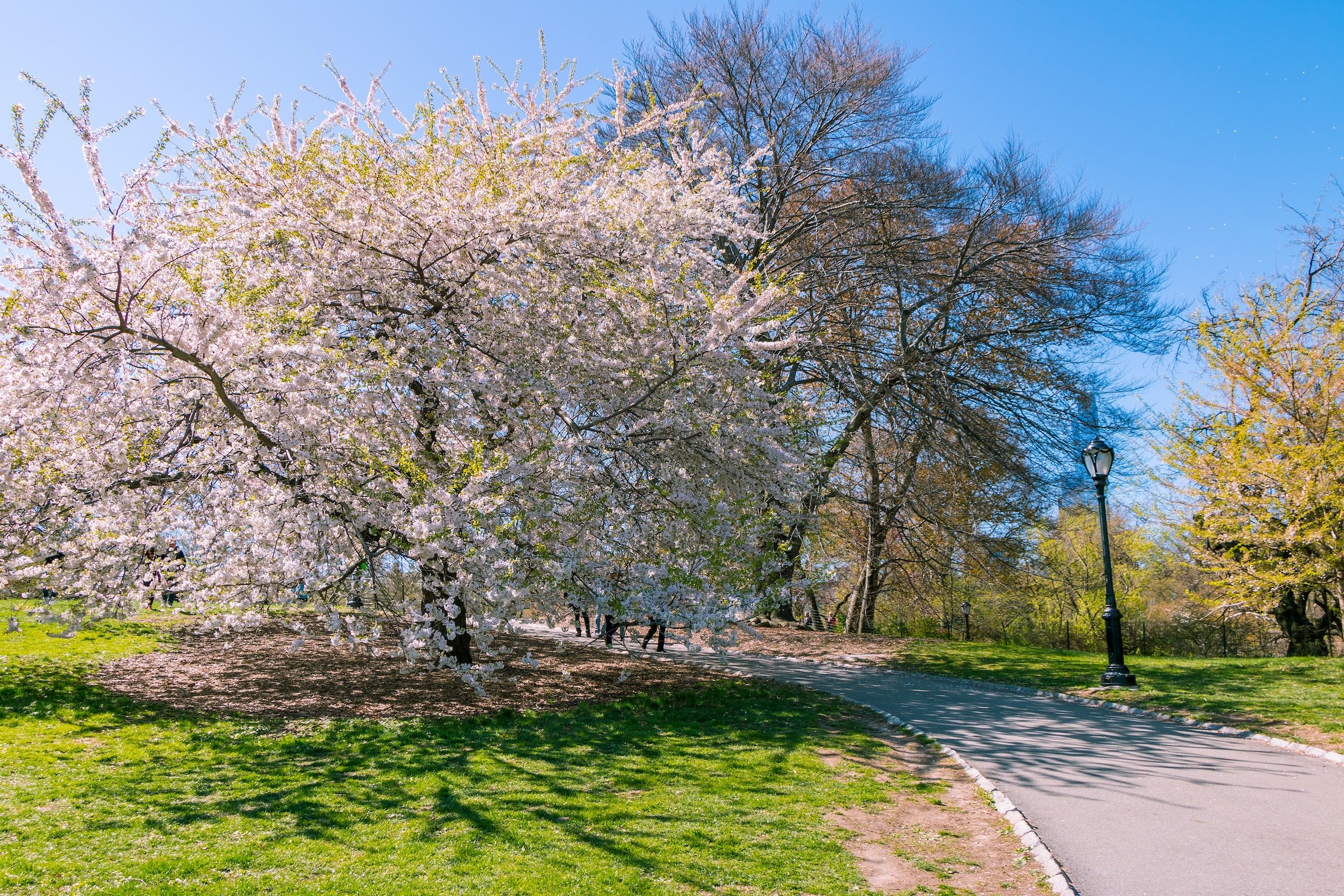
Cherry Hill is named for the flowering cherry trees that have become one of its defining features, particularly the Yoshino cherries whose pink and white blossoms cover the slope each spring. The Central Park Conservancy recognizes Cherry Hill as one of the park’s principal cherry-blossom landscapes.
The Concourse is equally historic. Olmsted and Vaux designed the top of the hill as a scenic carriage turnaround where riders could stop, rest their horses and enjoy elevated views across The Lake. The Conservancy continues to use the formal name Cherry Hill Concourse, making the expanded neighborhood name a direct reflection of the landscape’s original design.
History
1858–1873: Greensward Plan & Construction
Cherry Hill was deliberately shaped as both landscape and overlook.
Like the Great Hill farther north, Olmsted and Vaux conceived this elevated ground as a carriage concourse—a place where visitors could pause rather than simply pass through. The circular turnaround at the summit allowed carriages to stop while passengers looked outward across The Lake and the picturesque scenery surrounding it.
The relationship with the water was essential. The hill provided elevation above The Lake, while paths descending its slopes connected visitors with boating and shoreline recreation below. This combination of movement, stopping and prospect made Cherry Hill an early example of Central Park’s ability to make navigation itself part of the scenery.
1858–1899: Early History & Grand Openings
The Concourse’s central feature was designed during the 1860s by park architect Jacob Wrey Mould. What is now called Cherry Hill Fountain was originally a decorative drinking fountain for horses, directly serving the carriage turnaround surrounding it.
Mould envisioned an elaborate finial incorporating drinking saucers for birds and globed lamps above a granite-and-tile base. Only the lower portions of the design were initially realized, but the fountain still established a strong visual center for the Concourse.
Cherry Hill also became part of Central Park’s early sculptural landscape. Auguste-Nicolas Cain’s Tigress and Cubs was originally installed at the carriage concourse in 1867, where visitors could view it from their carriages. It was moved to the Central Park Zoo during the 1930s.
Below the hill, boating became one of Central Park’s earliest popular activities. Wagner Cove was one of six boat landings established around The Lake beginning in 1860, allowing passengers to travel between shoreline destinations and Bethesda Terrace.
20th Century: Transformation & Restoration
The Concourse lost much of its original purpose as carriage culture declined. For decades, the circular plaza was used as a parking lot, while the fountain stopped functioning and the surrounding landscape deteriorated.
That made Cherry Hill one of the important early restoration sites of the newly established Central Park Conservancy. In 1981, the Concourse was reclaimed from automobile parking and the fountain restored. The Conservancy also finally completed Mould’s unrealized upper design, adding the bird cups and lamps originally intended for the structure.
Another major restoration followed three decades later as part of the Conservancy’s six-year rehabilitation of The Lake and its shoreline. The Cherry Hill landscape and shoreline were restored first, followed in 2012 by reconstruction of the Concourse itself—renewing paving, plantings and the historic relationship between the hilltop turnaround and its views across the water.
Explore
21st Century: Renovation & Modernization
Today, Cherry Hill & Concourse is one of Central Park’s great seasonal landscapes.
Spring is unquestionably its signature moment. Yoshino cherry trees cover the hill in pale pink and white blossoms, framing views toward Bow Bridge, The Lake and Central Park West. The Conservancy lists Cherry Hill among the park’s premier destinations for cherry blossoms, and those blooms have made the landscape an increasingly popular spring destination.
But spring only reveals one version of the hill.
Summer fills the canopy and turns the lawn into a shaded refuge above the Lake. In autumn, the surrounding foliage reflects across the water while the Ramble and western skyline become part of a broad landscape of reds, oranges and golds. Winter removes much of that visual density, exposing the hill’s slopes, branches, Concourse and views—and after snow, the Lake below can appear almost completely transformed.
The Concourse remains one of the neighborhood’s best places simply to stop. Its original nineteenth-century purpose survives remarkably intact: visitors still arrive at the summit, circle the fountain, sit nearby and look outward across The Lake.
The difference is that horses no longer need watering.
Waypoints
-
Designed by Jacob Wrey Mould as a watering fountain for horses using the carriage Concourse, the ornate structure forms the centerpiece of the hilltop plaza. Its distinctive bird cups and globed lamps were finally added during the Conservancy’s 1981 restoration according to Mould’s original design.
-
Cherry Hill’s Yoshino cherries are among Central Park’s most celebrated spring displays. Many descend from trees presented to New York by Japan beginning in 1912, and their annual blossoms have become inseparable from the modern identity of the landscape.
-
Tucked along the southernmost shore of The Lake, Wagner Cove preserves one of Central Park’s original boating traditions. The current rustic landing was reconstructed in 2016 using historic documentation of the nineteenth-century boat landings that once carried visitors around The Lake.
Photography
Visual Identity
Central Park has no single visual identity. It moves between open meadow and enclosed woodland, exposed bedrock and carefully planted garden, reflective water and hard-edged skyline. Its paths can narrow into shade beneath old trees, then open suddenly toward towers, lakes, monuments, or a broad field filled with people. The Park’s character is made from those transitions: the designed discovery of one landscape giving way to another.
Water and horizon recur throughout its geography. The Lake, Reservoir, ponds, fountains, and seasonal pools of light create places of reflection—sometimes literal, sometimes figurative—where the city appears fractured, softened, or enlarged. Beyond them, Manhattan’s towers remain present as a constant reminder that this cultivated landscape exists within, not apart from, one of the world’s densest cities.
Its visual language also changes dramatically with the seasons. Winter exposes branches, stone, and skyline; spring briefly turns the Park into blossom and color; summer fills its lawns and paths with activity; autumn intensifies the drama of canopy, water, and light. Central Park is designed to be revisited, and its identity is never fixed for long.