
SHEEP MEADOW
Location
Geographic Setting
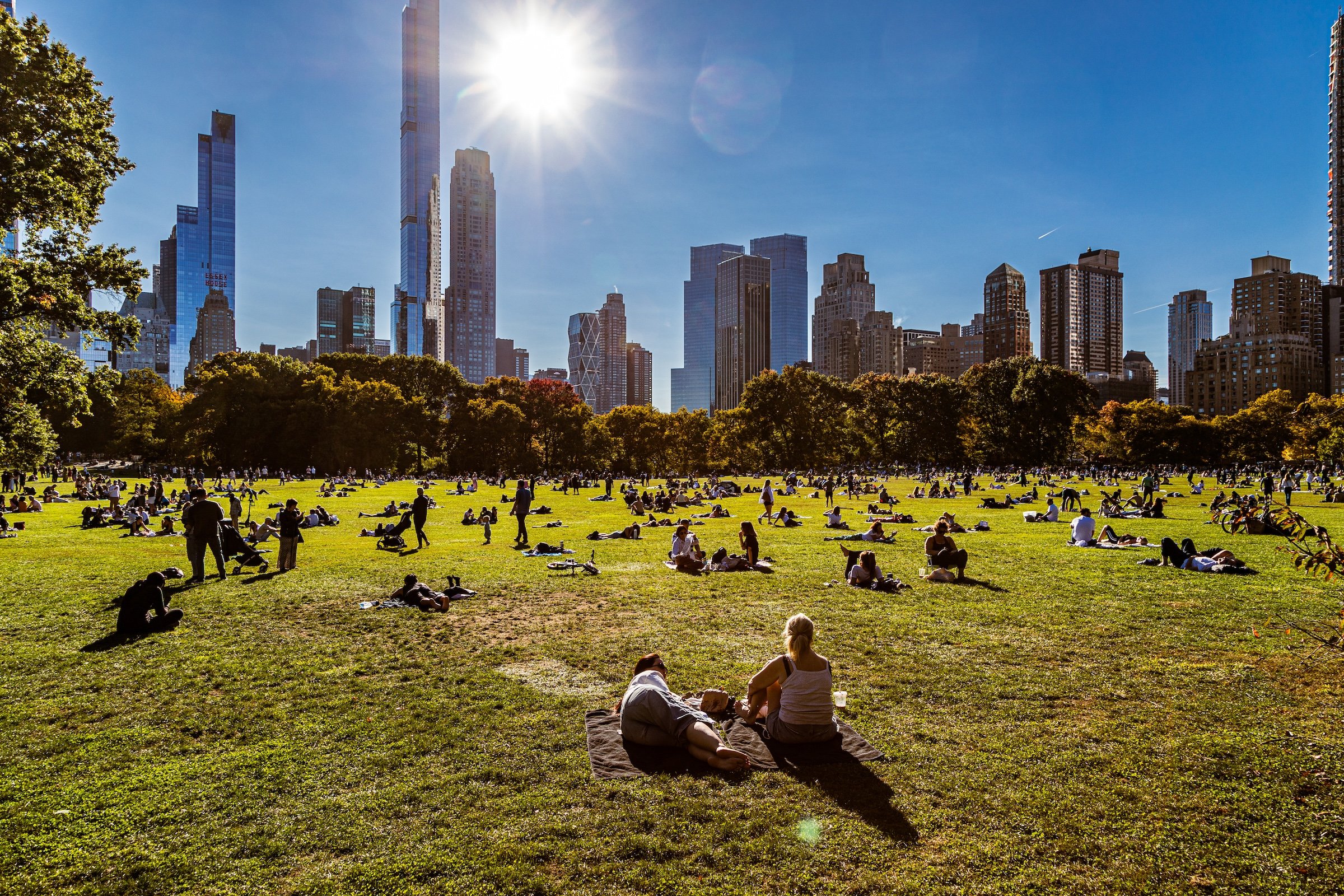
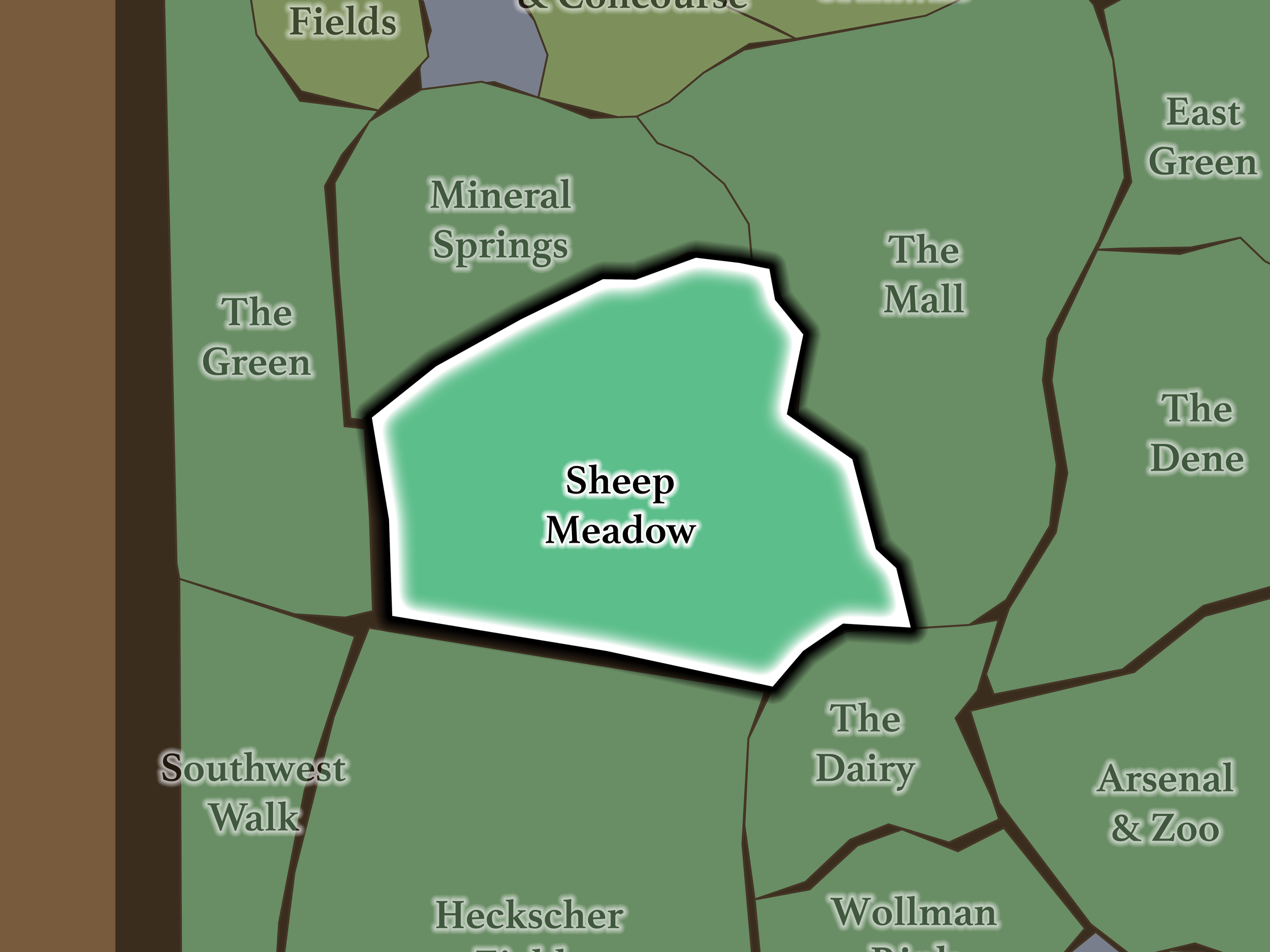
Sheep Meadow occupies one of the largest uninterrupted lawns in Central Park’s South End. The Green lies across West Drive to the west; Mineral Springs rises immediately north; The Mall forms the landscape beyond its eastern edge; while The Dairy and Heckscher Fields lie to the south beyond Center Drive and 65th Street.
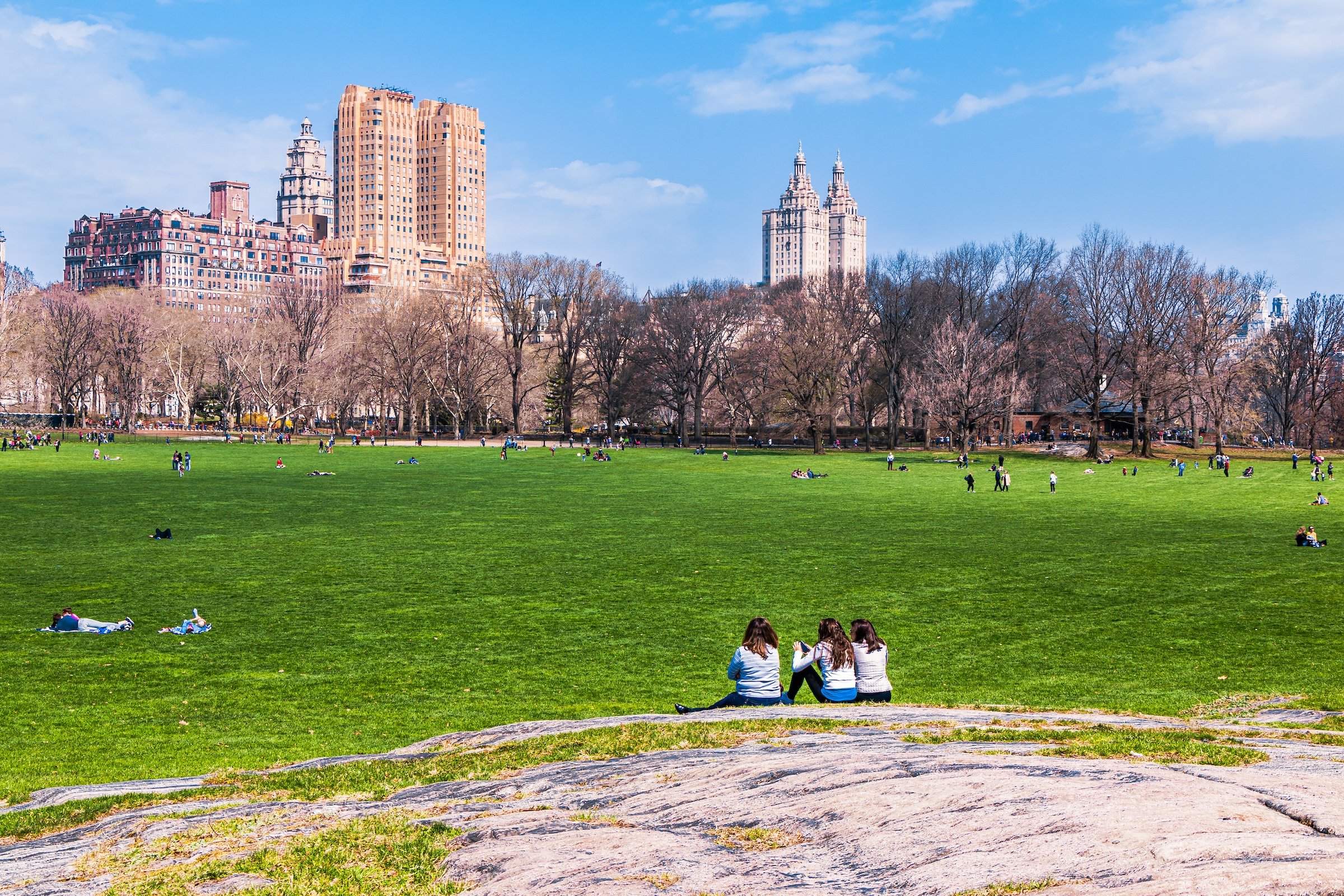
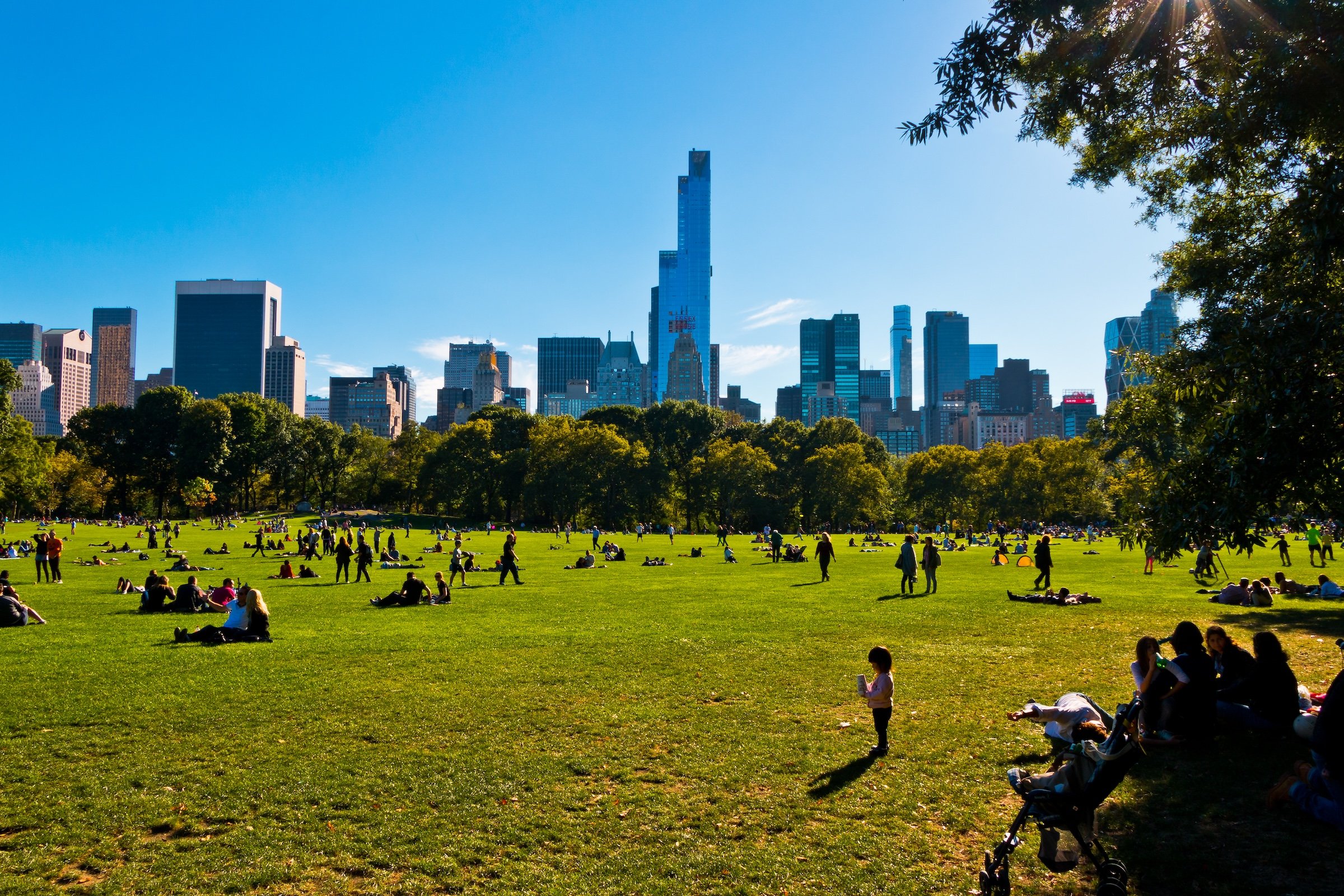
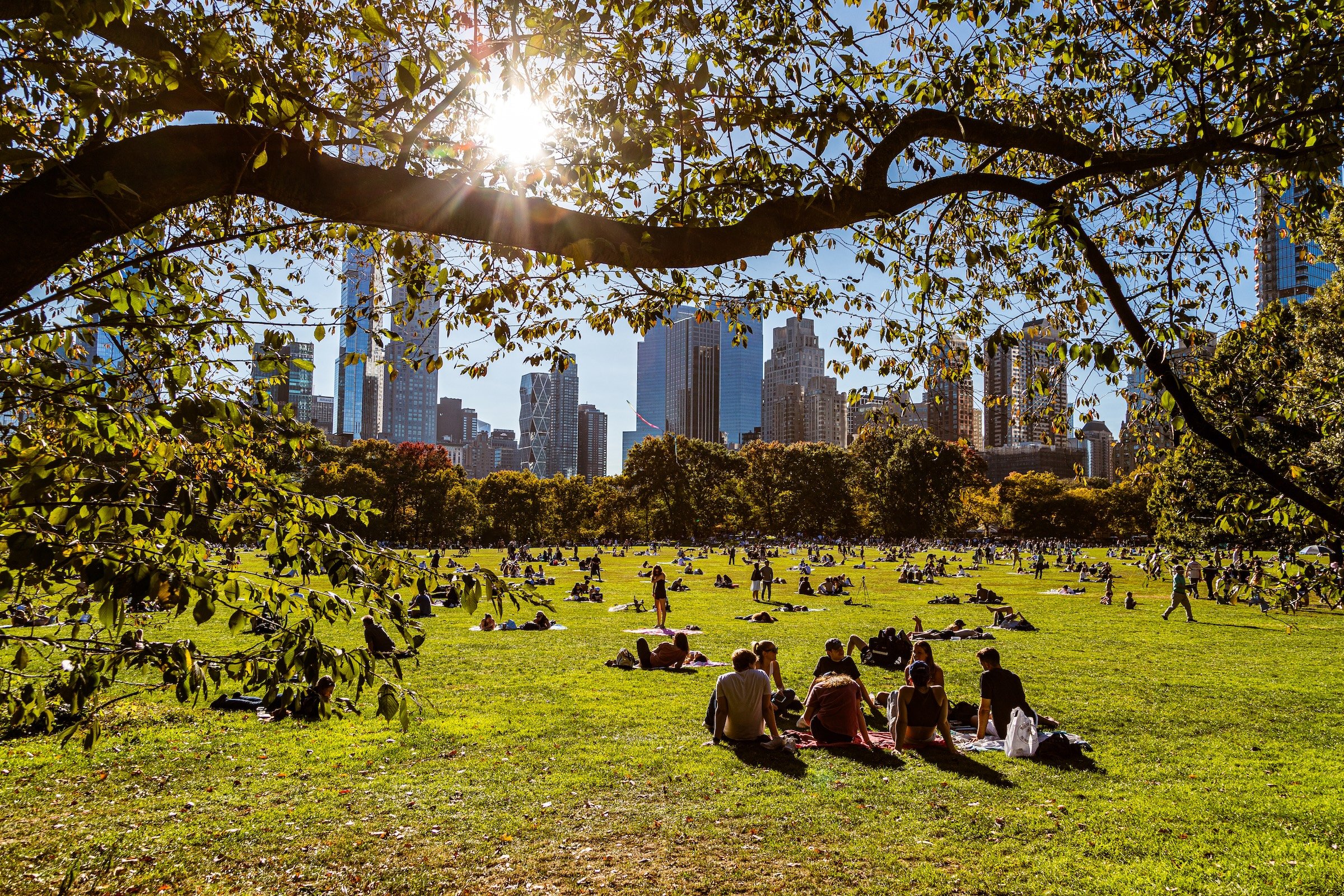
Its defining characteristic is openness. A broad, nearly fifteen-acre lawn sits within a perimeter of mature trees, creating an enormous opening in the park canopy. Those trees soften the surrounding city without completely hiding it: Midtown’s towers rise above the southern treeline while the historic apartment buildings of Central Park West frame the western horizon.
Etymology
Sheep Meadow takes its name from the flock of sheep that grazed across its broad lawn from 1864 until 1934. Their presence was practical—they kept the grass cropped—but also deliberately picturesque, reinforcing Olmsted and Vaux’s vision of Central Park as a pastoral retreat from the city.
History
The Greensward Plan
Sheep Meadow began with a contradiction in Olmsted and Vaux’s design. The competition specifications for Central Park required a military parade ground, despite the designers’ belief that drilling soldiers conflicted with the peaceful rural atmosphere they wanted the park to create. They therefore placed the Parade Ground on the western side and kept it comparatively restrained.
Creating that apparently effortless greensward required considerable intervention. The existing terrain was uneven and rocky, and the broader pre-park landscape included glacial outcrops and, near the future Sheepfold site, industries such as bone boiling associated with Manhattan’s nineteenth-century sugar-refining trade. Olmsted and Vaux’s pastoral lawn was therefore not preserved countryside but a carefully reconstructed version of it.
The Grand Opening
The military function proved short-lived. In 1864, approximately 150 sheep were introduced to strengthen the meadow’s pastoral character. After militia members entered the meadow without authorization and disrupted the flock, military drilling was eventually prohibited, allowing the landscape to settle fully into its pastoral role.
A dedicated Sheepfold, designed by Jacob Wrey Mould, was completed beside West Drive in 1870. Twice each day, the shepherd stopped traffic while the flock crossed between the fold and the meadow—a remarkably literal realization of Central Park’s cultivated rural illusion.
The landscape also acquired sculpture during these early decades. John Quincy Adams Ward’s Indian Hunter, dedicated in 1869 near the meadow’s eastern edge, was celebrated as an attempt to create a distinctly American form of monumental sculpture appropriate to Central Park’s rustic surroundings.
20th Century
The sheep remained a familiar Central Park sight until 1934, when they were removed and the Sheepfold was converted into Tavern on the Green. Without its flock, the meadow gradually evolved from picturesque pasture into one of New York’s great public gathering spaces.
That transformation accelerated during the 1960s and 1970s. Sheep Meadow hosted concerts, demonstrations and mass gatherings, including Barbra Streisand’s enormous 1967 concert. Heavy use combined with decades of inadequate maintenance eventually reduced much of the lawn to bare earth. A 1979 James Taylor concert drew roughly 250,000 people shortly before the badly damaged meadow was closed for restoration.
Its restoration became one of the earliest symbols of Central Park’s revival. Work begun in 1979 returned healthy turf to the landscape, and care of the newly restored Sheep Meadow became one of the young Central Park Conservancy’s first major maintenance responsibilities.
Explore
Contemporary Landscape
Today, Sheep Meadow is perhaps Central Park’s purest expression of the pastoral ideal: an enormous grassy room enclosed by trees but open completely to the sky.
Once inside, much of the park’s noise seems to recede. The lawn creates enough distance that Manhattan changes scale—the towers of Midtown and the great residences of Central Park West become scenery rather than surroundings. The result is one of the park’s most dramatic combinations of city and escape: skyline, sky, lawn and treeline occupying the same uninterrupted view.
The meadow is now managed as a quiet zone, prioritizing picnicking, sunbathing, reading and informal relaxation rather than organized field sports. Intensive turf management and seasonal closures protect a landscape whose apparent simplicity depends upon continuous care.
Waypoints
-
John Quincy Adams Ward’s 1869 bronze depicts a Native American hunter accompanied by his dog. Its naturalistic subject was considered particularly appropriate to Central Park’s rural character when it was installed.
-
A narrow path along Sheep Meadow’s northern edge passes through lilacs gathered from varieties around the world. Funded by philanthropist Nell Singer and dedicated in 1970, the planting is especially prominent from late April into early summer.
-
A rounded glacial outcrop along the meadow’s edge preserves some of the natural geology that survives around a landscape otherwise dramatically reshaped into open lawn.
-
Sand and asphalt courts along the meadow’s eastern side provide one of the few explicitly active recreational spaces immediately adjoining this otherwise quiet landscape.
Photography
Visual Identity
Central Park has no single visual identity. It moves between open meadow and enclosed woodland, exposed bedrock and carefully planted garden, reflective water and hard-edged skyline. Its paths can narrow into shade beneath old trees, then open suddenly toward towers, lakes, monuments, or a broad field filled with people. The Park’s character is made from those transitions: the designed discovery of one landscape giving way to another.
Water and horizon recur throughout its geography. The Lake, Reservoir, ponds, fountains, and seasonal pools of light create places of reflection—sometimes literal, sometimes figurative—where the city appears fractured, softened, or enlarged. Beyond them, Manhattan’s towers remain present as a constant reminder that this cultivated landscape exists within, not apart from, one of the world’s densest cities.
Its visual language also changes dramatically with the seasons. Winter exposes branches, stone, and skyline; spring briefly turns the Park into blossom and color; summer fills its lawns and paths with activity; autumn intensifies the drama of canopy, water, and light. Central Park is designed to be revisited, and its identity is never fixed for long.