
NORTH MEADOW
Location
Geographic Setting
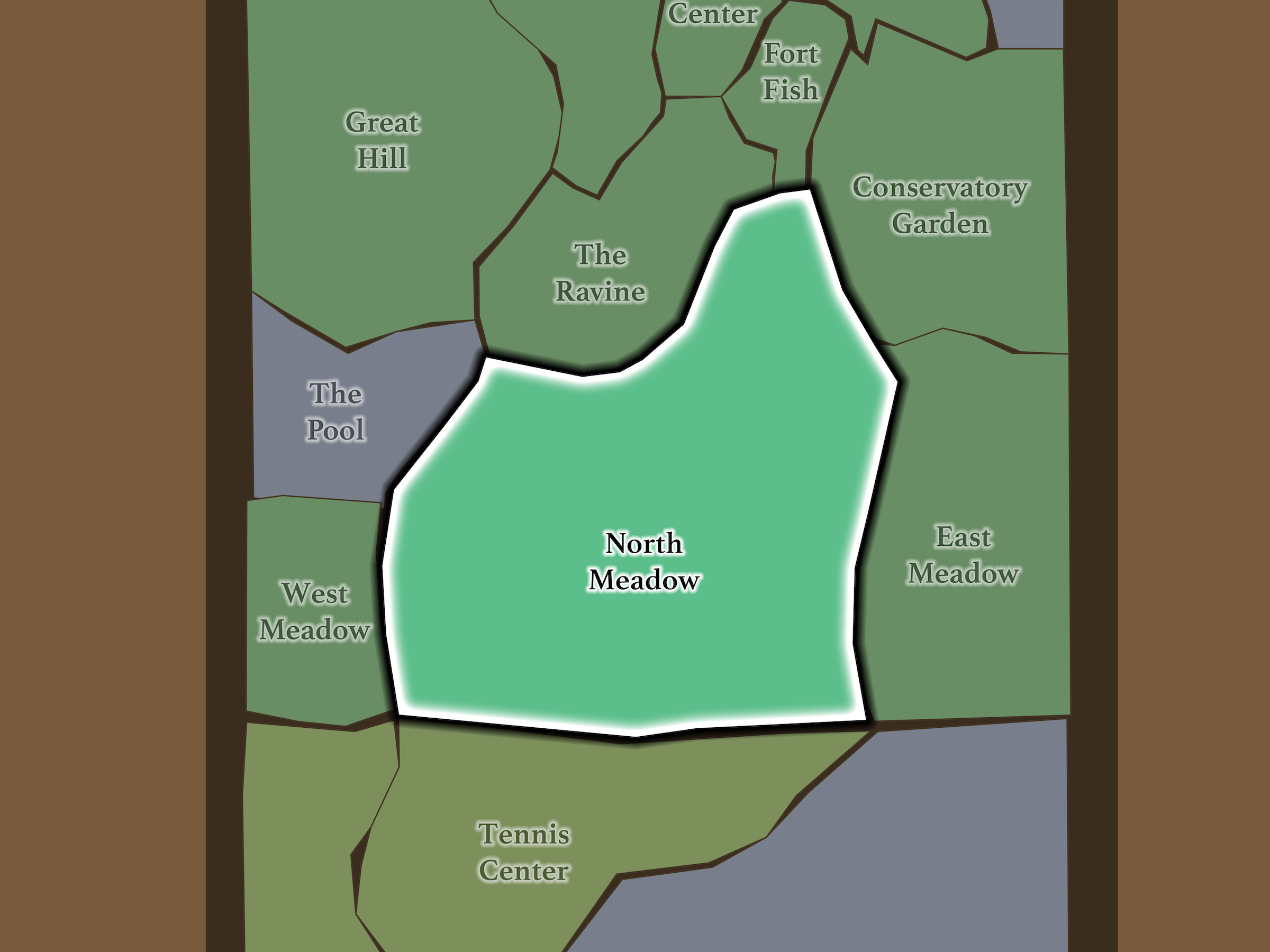
North Meadow fills much of the southern center of the North End. The Pool and the western meadow landscapes lie beyond West Drive; The Ravine and Fort Fish begin above the 102nd Street Crossing; Conservatory Garden and East Meadow lie across East Drive; and the Tennis Center begins beyond the 97th Street Transverse.
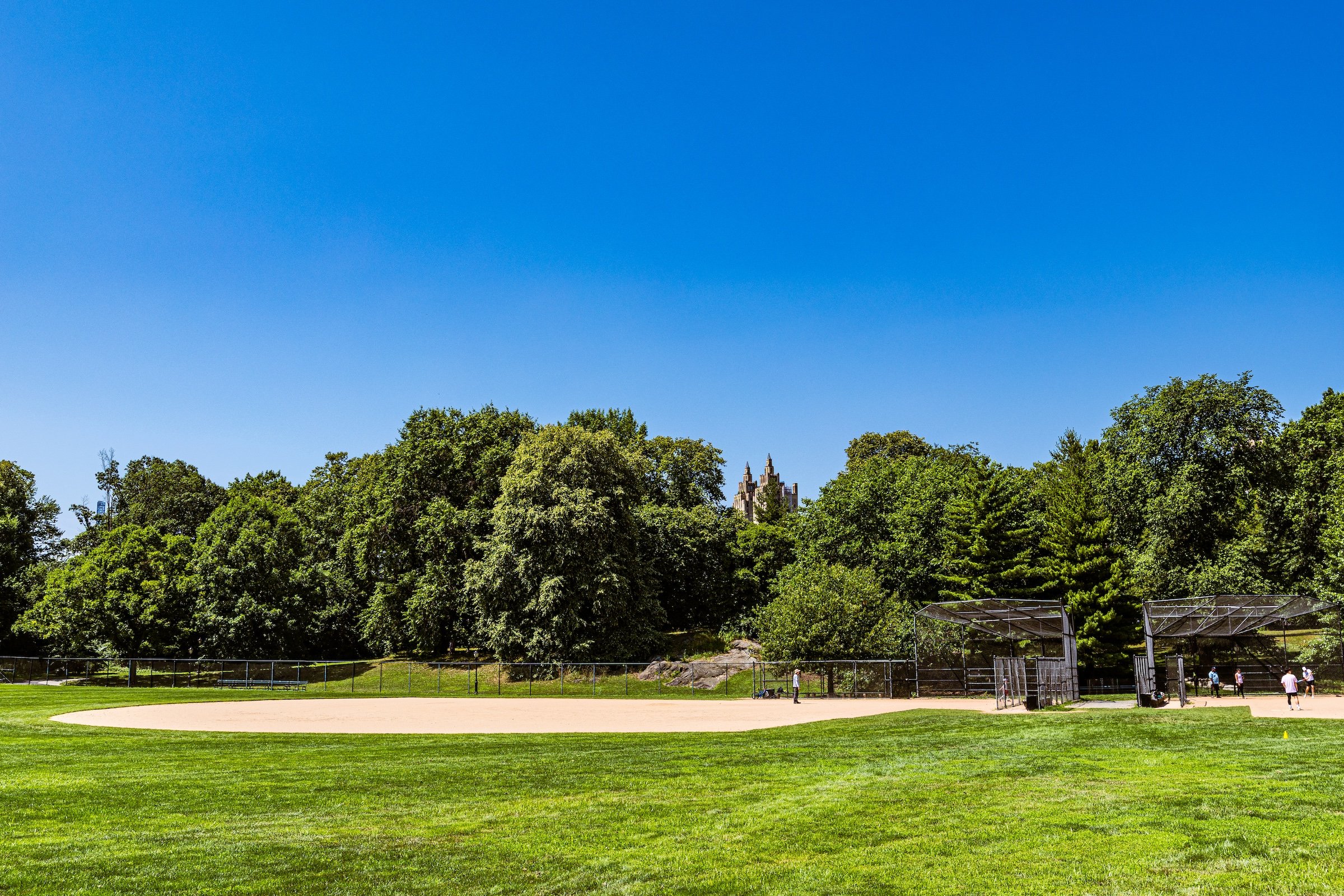
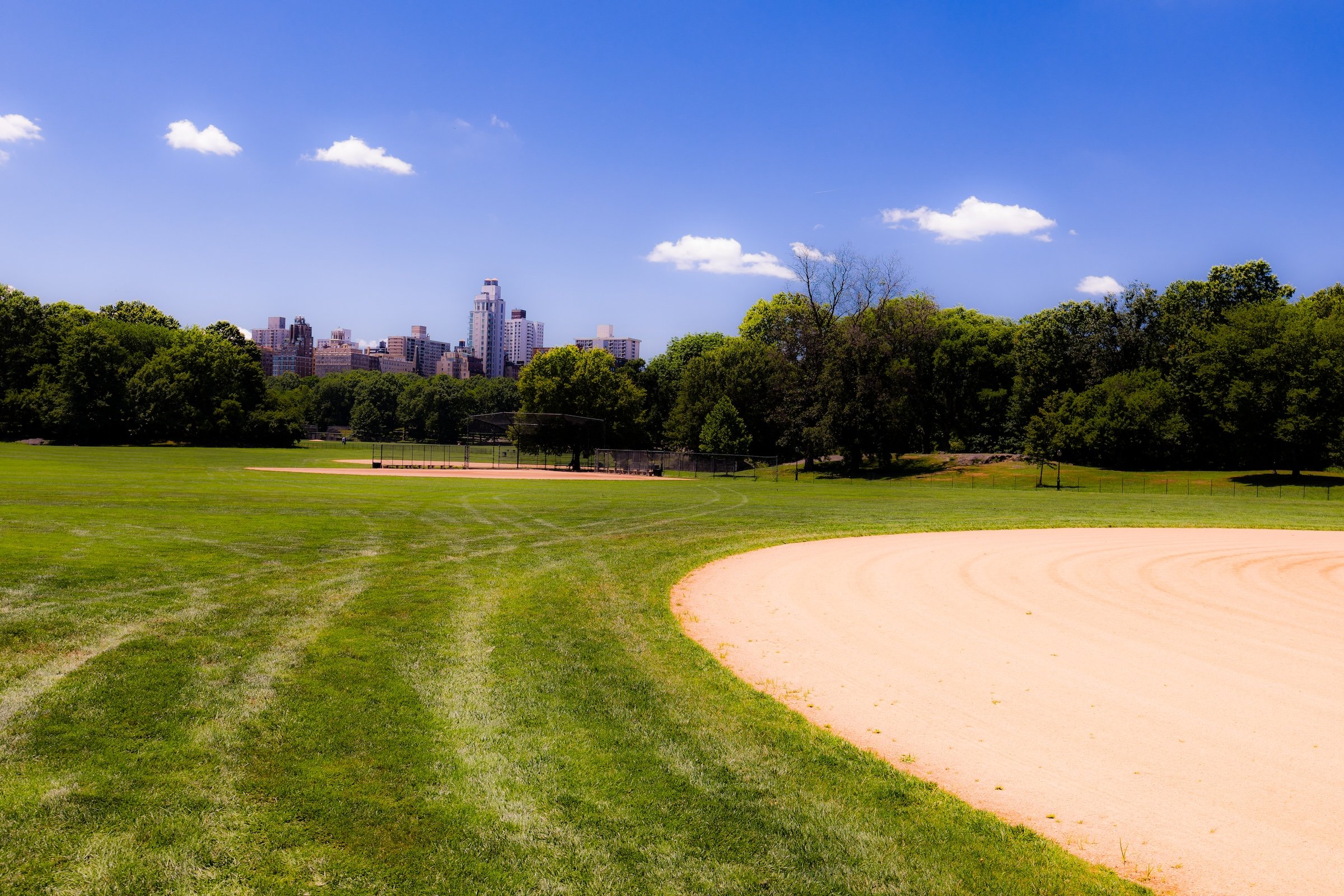
Its broad central lawn is ringed by mature trees and punctuated by dirt diamonds, backstops and occasional exposures of Manhattan schist. That enclosure creates an interesting scale: the Meadow is enormous when standing inside it, yet the surrounding tree line largely screens the rest of Central Park and Manhattan.
North Meadow therefore reads simultaneously as sports complex and pastoral clearing.
Etymology
North Meadow takes its name from both its position and its defining landscape: a broad open meadow occupying the southern portion of Central Park’s North End between approximately 97th and 102nd Streets.
At roughly 20 acres, it is the largest of Central Park’s open meadow landscapes. Today it contains twelve fields used for baseball, softball, soccer and football, but its identity remains larger than the sports played upon it: grass, sky and a broad perimeter of trees give North Meadow the pastoral scale its name implies.
History
1858–1873: Greensward Plan & Construction
North Meadow occupies ground Olmsted and Vaux initially considered for something closer to a formal playground—in the nineteenth-century sense of a large open ground for games such as baseball and cricket.
Demand for such recreation appeared almost as soon as Central Park was being constructed. Clubs petitioned the commissioners for places to skate, play cricket and particularly play the rapidly growing sport of baseball. But only one formal Playground—the landscape that ultimately became Heckscher Fields—was constructed according to that original idea.
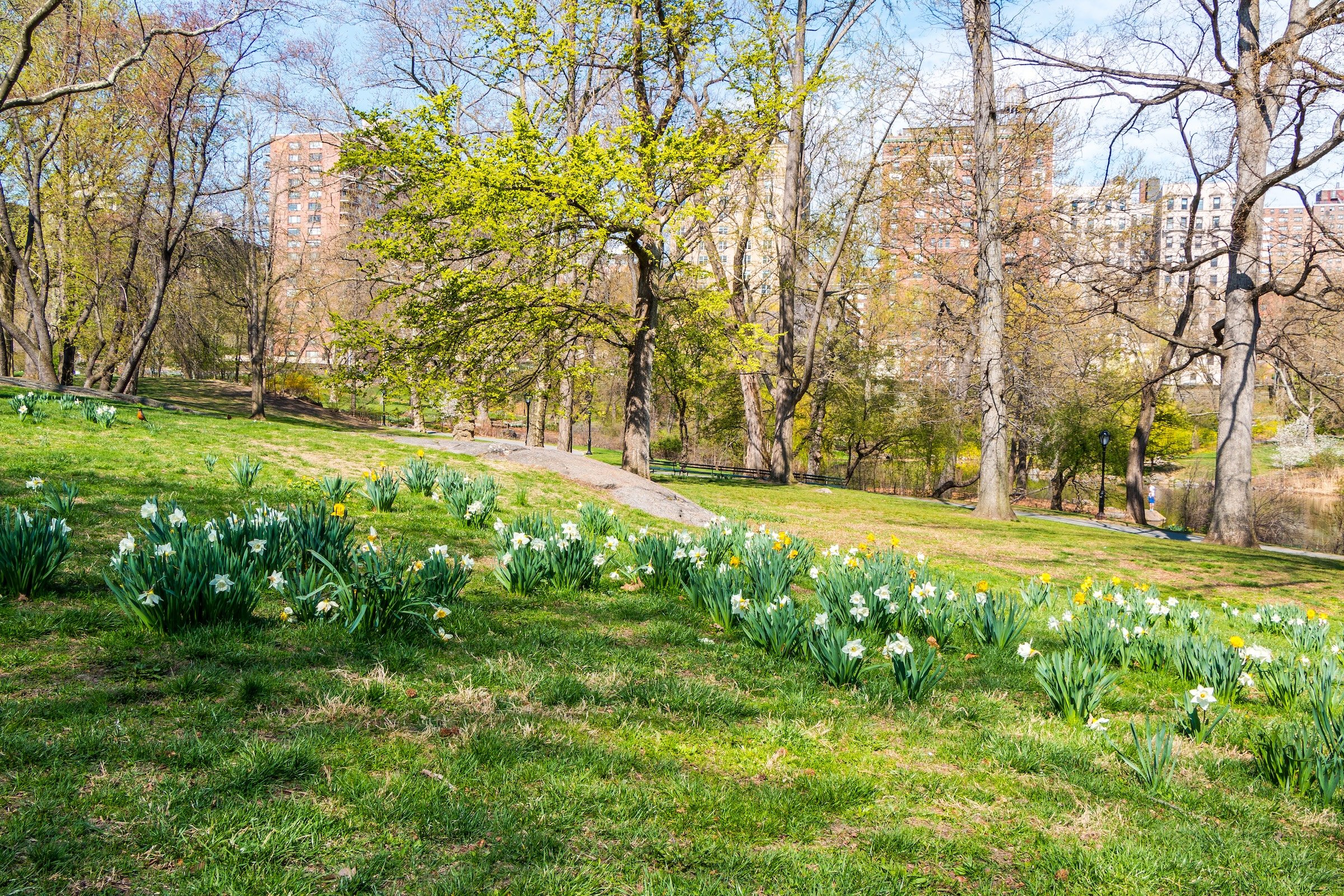
North Meadow instead developed principally as pastoral scenery: an open greensward intended to provide visual relief, fresh air and the impression of countryside within Manhattan. The Conservancy still identifies it as one of the clearest surviving examples of Central Park’s pastoral landscape tradition.
1858–1899: Early History & Grand Openings
During Central Park’s nineteenth-century decades, North Meadow was consequently much less specialized than it is today.
The open grass could accommodate informal recreation while remaining fundamentally meadow. During the later nineteenth century, portions were flattened for lawn tennis, an early sign that increasingly organized sports were beginning to reshape the landscape.
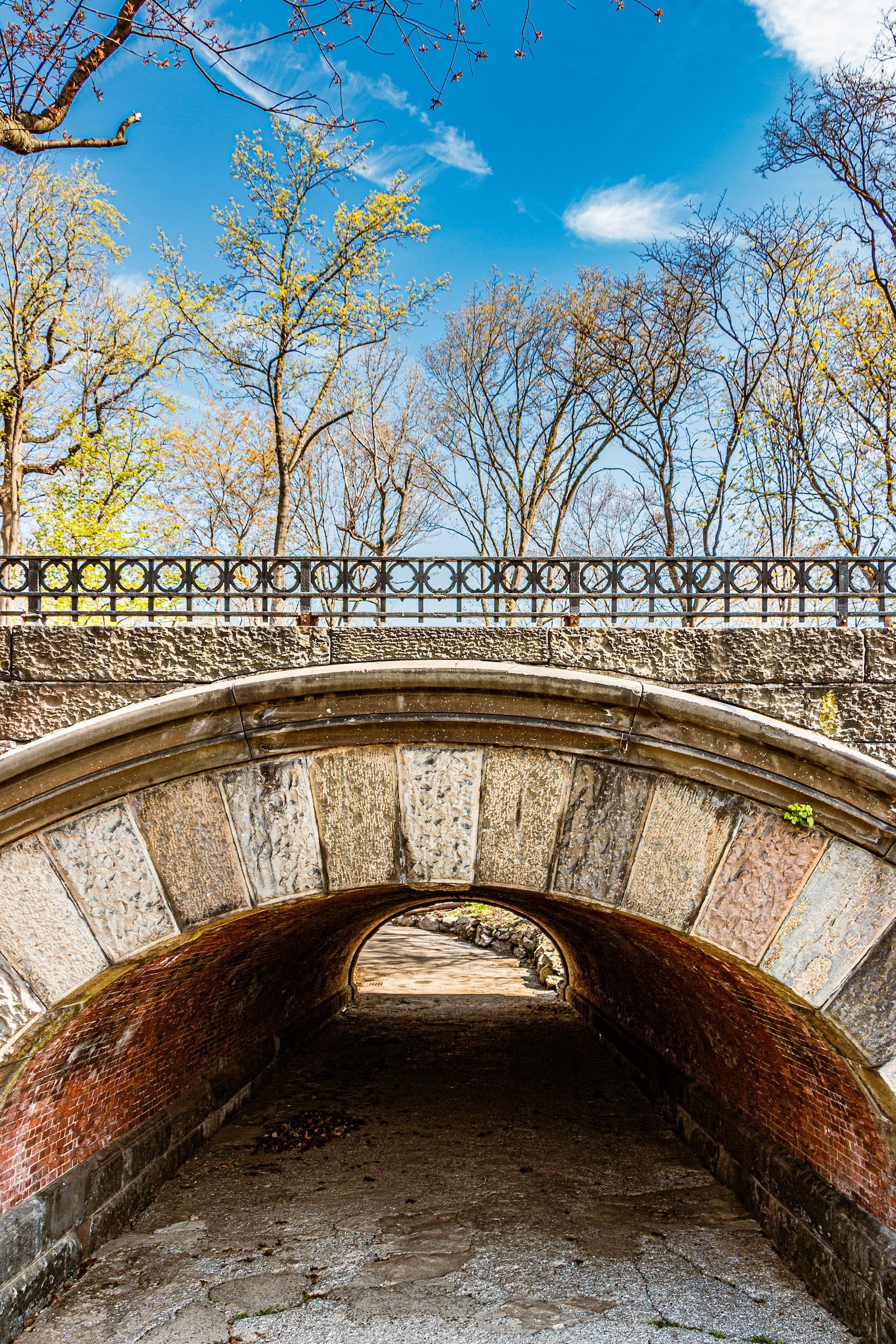
At its northern edge, Springbanks Arch became part of the intricate circulation system connecting North Meadow with the Ravine. The arch carries the Bridle Path above a pedestrian route while a natural spring once flowed through the same tunnel beside the walkway. Although paving later concealed the spring, water can reportedly still be heard moving beneath the path after heavy rains.
The landscape was therefore already doing two things at once: providing broad pastoral openness while participating in the layered roads, paths and waterways surrounding the North End.
20th Century: Transformation & Restoration
The twentieth century decisively shifted North Meadow toward organized recreation.
Growing enthusiasm for baseball, soccer and other sports led to increasingly intensive use. In 1935, eight permanent baseball fields were installed, requiring substantial leveling and filling of the Meadow’s previously rolling terrain. In 1954, the layout was reconfigured again to accommodate the present total of twelve playing fields.
The North Meadow Center followed a related transformation. The complex began in 1910 as a maintenance yard containing a stone storage building, stable, incinerator and manure pits. Under Parks Commissioner Robert Moses in 1935, portions were converted for public recreation, including restrooms and outdoor athletic facilities.
Decades of intensive sports use eventually compacted the soil and overwhelmed drainage. Beginning in 1997, NYC Parks and the Central Park Conservancy undertook a major restoration intended to reconcile organized recreation with the Meadow’s older pastoral identity. Fields, soils and drainage were reconstructed while the surrounding landscape was restored to recover some of its scenic character.
Explore
21st Century: Renovation & Modernization
Today, North Meadow is one of Central Park’s most active landscapes—but it still feels unmistakably like a meadow.
During warm months, it is rare to cross the landscape without encountering a game underway. Its twelve fields host baseball and softball in spring and summer, while soccer and touch football become prominent later in the year. Organized games require permits, and the Meadow closes during winter so its heavily used turf can recover.
Yet recreation never completely overwhelms the landscape.
The ballfields sit within one enormous green room. Mature trees define its outer perimeter, rock outcrops interrupt the turf, and wide expanses of grass remain available for picnicking, strolling or simply watching games. The diamonds and backstops become accents within the landscape rather than walls dividing it into twelve isolated facilities.
That distinction helps separate North Meadow from the Great Lawn. Both combine open space with organized sports, but North Meadow feels less monumental and less civic. It is closer to a vast neighborhood recreation ground—busy with leagues and pickup games, yet enclosed by the rougher, quieter landscapes of the North End.
The recently restored North Meadow Center reinforces that role. Its latest reconstruction renewed the historic building, handball courts and surrounding landscape while adding two dedicated pickleball courts and upgraded public facilities. The Conservancy deliberately used new planting to visually integrate the operational complex back into the Meadow rather than allowing it to dominate the landscape.
Waypoints
-
Twelve fields occupy the Meadow today, supporting baseball, softball, soccer and football through different parts of the year. Their development transformed the landscape during the twentieth century, but restoration has worked to preserve both intensive recreation and the Meadow’s pastoral character.
-
An informal name used particularly by Central Park’s birding community for the small rise at the northeastern corner of the North Meadow ballfields. Its slightly elevated, tree-lined setting provides a transition between the open playing fields and the more varied landscapes toward the Ravine and East Meadow.
-
Located beside the North Meadow Center, the courts belong to the recreational complex developed here beginning in the 1930s. They were recently reconditioned as part of the Center’s comprehensive restoration.
-
Originally constructed as a maintenance facility in 1910 and adapted for recreation beginning in 1935, the Center now provides public restrooms and supports basketball, handball, pickleball and other activities alongside the Meadow’s field sports.
-
One of the North End’s more secluded original arches, Springbanks carries the Bridle Path above the pedestrian connection between North Meadow and the Ravine. Its name recalls the natural spring that once flowed openly through the passage and can still sometimes be heard beneath the paving.
Photography
Visual Identity
Central Park has no single visual identity. It moves between open meadow and enclosed woodland, exposed bedrock and carefully planted garden, reflective water and hard-edged skyline. Its paths can narrow into shade beneath old trees, then open suddenly toward towers, lakes, monuments, or a broad field filled with people. The Park’s character is made from those transitions: the designed discovery of one landscape giving way to another.
Water and horizon recur throughout its geography. The Lake, Reservoir, ponds, fountains, and seasonal pools of light create places of reflection—sometimes literal, sometimes figurative—where the city appears fractured, softened, or enlarged. Beyond them, Manhattan’s towers remain present as a constant reminder that this cultivated landscape exists within, not apart from, one of the world’s densest cities.
Its visual language also changes dramatically with the seasons. Winter exposes branches, stone, and skyline; spring briefly turns the Park into blossom and color; summer fills its lawns and paths with activity; autumn intensifies the drama of canopy, water, and light. Central Park is designed to be revisited, and its identity is never fixed for long.