
NATURALISTS’ WALK
Location
Geographic Setting
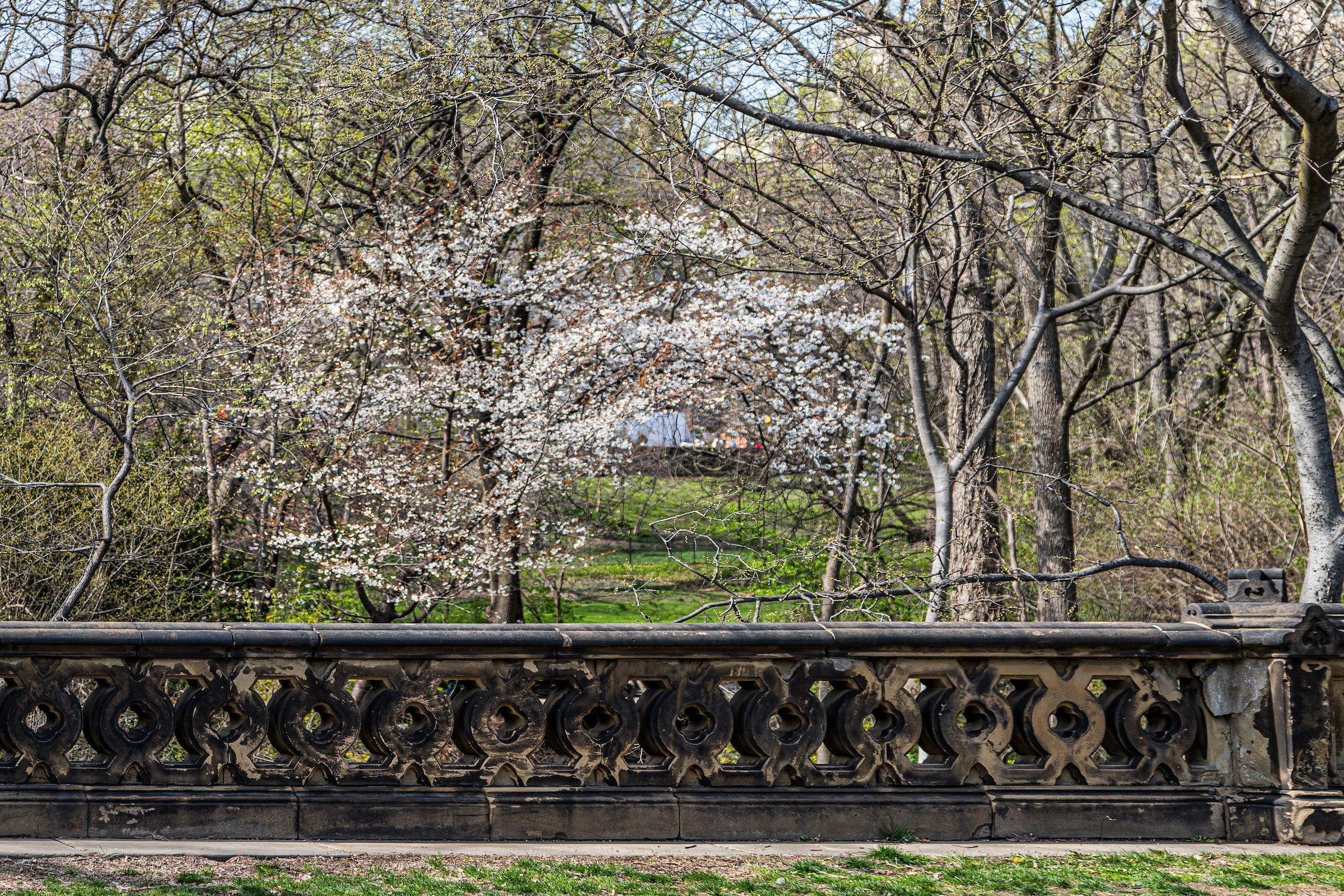
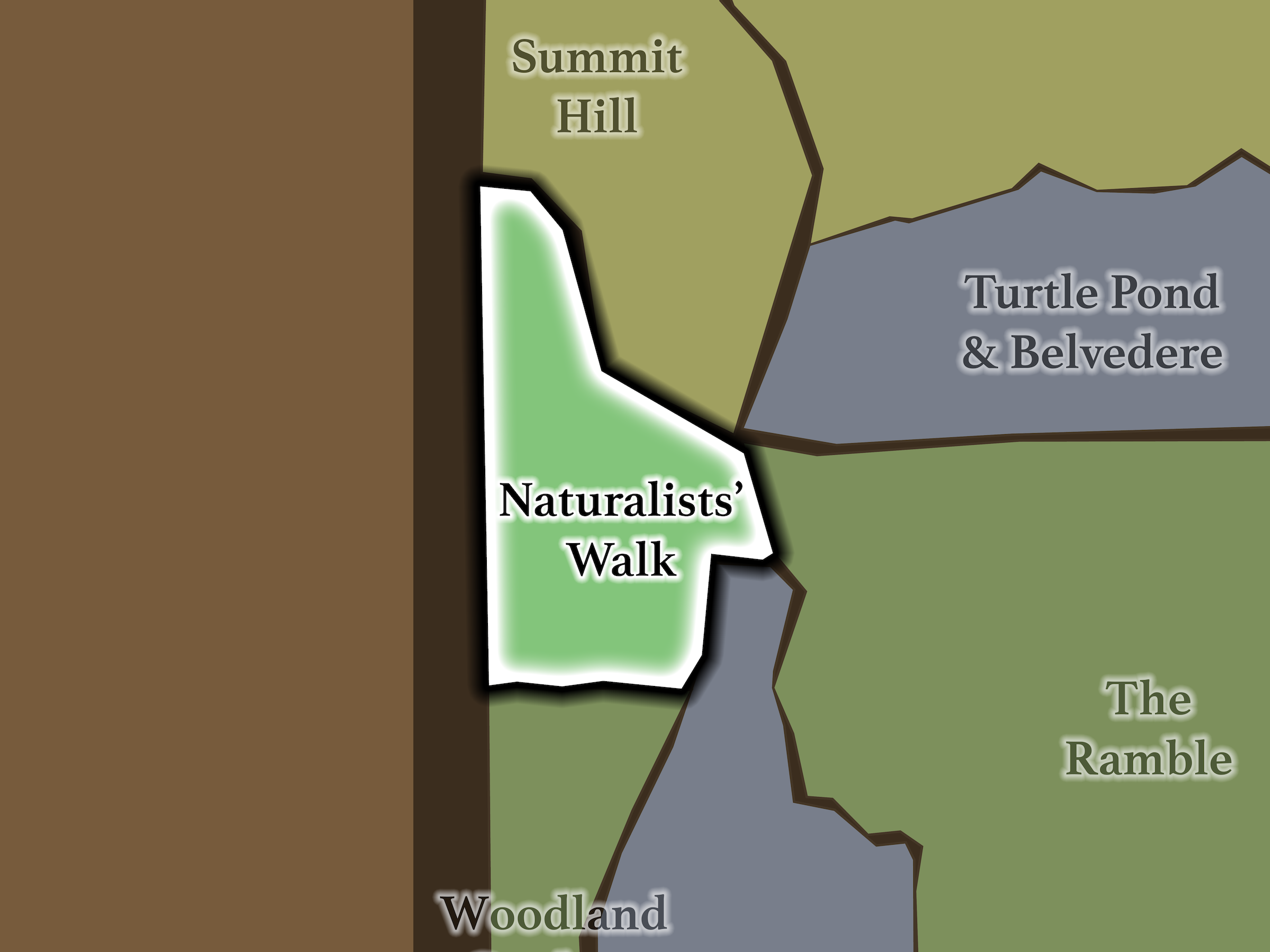
Naturalists’ Walk forms a narrow, rugged corridor along the western edge of Mid-Park South. The Ramble and The Lake lie beyond West Drive to the east; Woodland Gardens begins below West 77th Street; the American Museum of Natural History stands directly across Central Park West; and Summit Rock begins beyond the 79th Street Transverse to the north.
Much of the landscape sits below the grade of Central Park West, which gives it an unexpectedly secluded character despite the Museum and Upper West Side immediately beyond the trees. Dense canopy, Manhattan schist, small lawns, a stream and winding paths compress several characteristic Central Park environments into a remarkably small area.
Etymology
Naturalists’ Walk is not simply a CityNeighborhoods designation—it is an established Central Park landscape name. The Central Park Conservancy defines Naturalists’ Walk as the wooded area extending along the park’s western edge from approximately West 77th to West 81st Streets. Its name comes directly from Naturalists’ Gate at West 77th Street, while its placement opposite the American Museum of Natural History reinforces the theme.
That association became even more explicit when the Conservancy reconstructed the landscape in the 1990s. Its 1995 annual report described Naturalists’ Walk as an “outdoor complement” to the Museum, intended to introduce visitors to Central Park’s plants, wildlife and geology.
History
1858–1873: Greensward Plan & Construction
The landscape that became Naturalists’ Walk originally revolved around a very different feature: Ladies Pond.
This small extension of The Lake occupied the low ground near West 78th Street and was reserved during winter for women ice skaters. Nearby, what is now called Eaglevale Arch carried the West 77th Street entrance above both the Bridle Path and a pedestrian route; its eastern opening originally towered directly above Ladies Pond.
That arrangement captures the complexity of Olmsted and Vaux’s original western landscape. Water, rock, bridle routes, pedestrian paths and entrance circulation occupied different elevations within a very confined strip of parkland.
1858–1899: Early History & Grand Openings
During Central Park’s nineteenth-century decades, Ladies Pond gave this landscape a much stronger relationship with The Lake than exists today. The pond provided women with a more private alternative to the highly social mixed-gender skating scene elsewhere on the Lake, while paths and bridges carried visitors around and above the water.
The neighborhood also acquired an appropriate cultural figure. Gustav Bläser’s bust of Alexander von Humboldt, the great German naturalist, explorer and geographer, was unveiled in Central Park in 1869 to commemorate the centenary of his birth. Although originally installed near Scholars’ Gate at Fifth Avenue and 59th Street, it would eventually become inseparable from Naturalists’ Walk.
20th Century: Transformation & Restoration
The landscape changed substantially during the 1930s. Ladies Pond was filled, and its former basin became the meadow that survives today within Naturalists’ Walk. What had once been water therefore became a small terrestrial clearing surrounded by rock and woodland.
In 1981, the Humboldt monument was moved from the South End to its present location at West 77th Street, directly opposite the American Museum of Natural History. That relocation gave Naturalists’ Gate a literal naturalist and strengthened the thematic connection between the Museum and the park landscape.
The defining transformation came during the 1990s. The Central Park Conservancy identified the underused landscape between West 77th and 81st Streets for reconstruction as Naturalists’ Walk. Funded by Pamela and Stanley Chais, the project was conceived specifically as an outdoor nature-education landscape associated with the Museum across the street. It incorporated ancient rock outcrops, native trees and plants, a restored stream and ravine, bird habitat, stepping stones and a new rustic footbridge.
The restored landscape was completed in 1996.
Explore
21st Century: Renovation & Modernization
Today, Naturalists’ Walk feels like a compressed sample of Central Park itself.
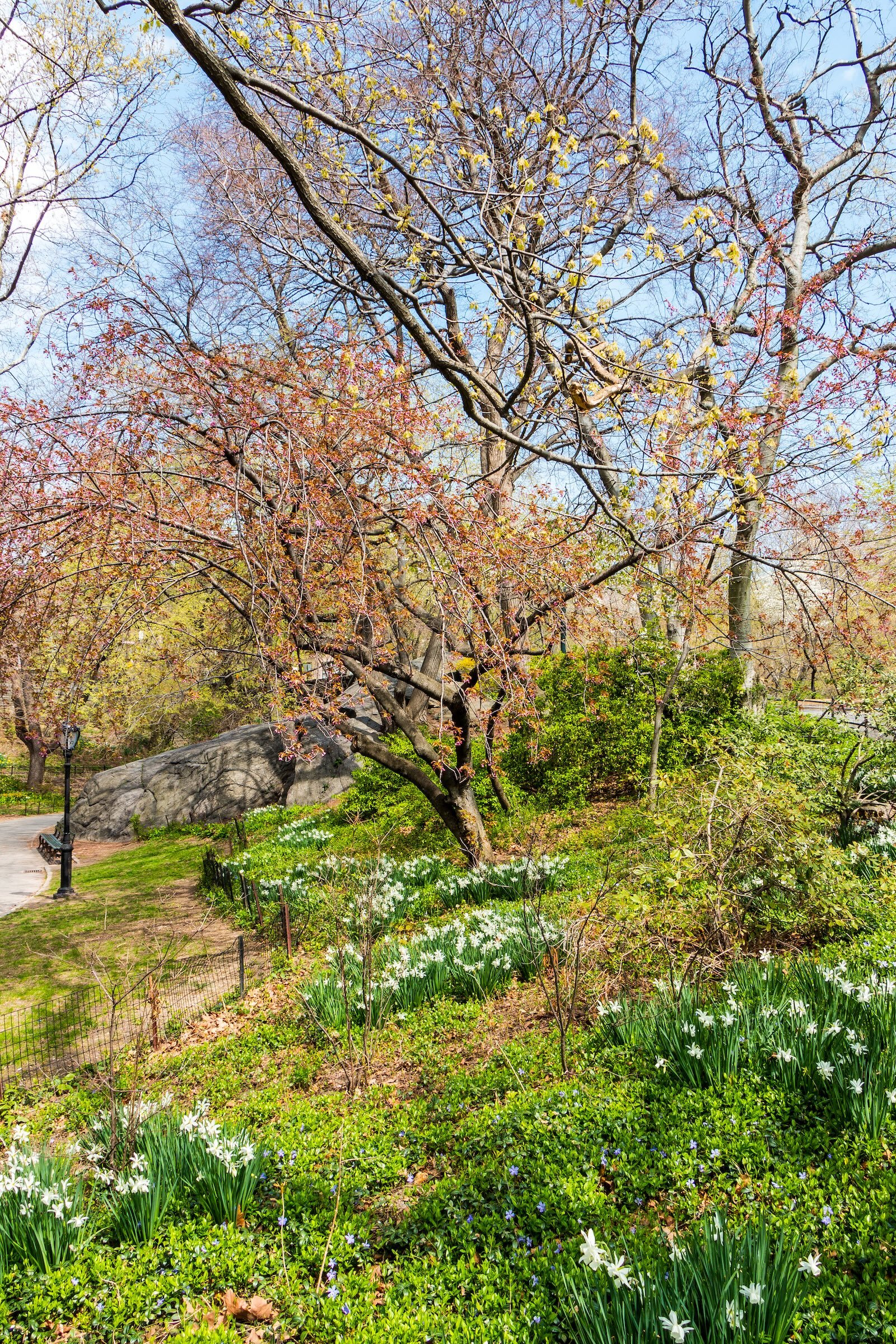
Within only a few blocks, paths encounter large exposures of Manhattan schist, mature woodland, native understory planting, meadow, flowing water and changes in elevation. The Conservancy specifically highlights the landscape as one of the better places in the park to encounter its geology at close range.
Its sunken position is crucial to the experience. Central Park West and the Museum may be only yards away, but both frequently disappear behind trees and rock. The result is a surprisingly rugged transitional corridor between Woodland Gardens to the south and Summit Rock to the north.
And the Museum relationship makes the landscape unusually satisfying conceptually. You can examine geology, ecology and natural history inside one of the world’s great museums, cross Central Park West through Naturalists’ Gate, and immediately encounter the living material outside: rock, stream, trees, birds and seasonal change.
Naturalists’ Walk is therefore both passage and outdoor exhibit.
Waypoints
-
Gustav Bläser’s 1869 portrait honors one of the nineteenth century’s most influential naturalists and explorers. Relocated here in 1981, Humboldt now serves almost as the symbolic guardian of Naturalists’ Gate and the landscape beyond it.
-
The West 77th Street entrance belongs to Central Park’s original system of gates named for the people and occupations of New York. Its natural-history identity is reinforced by the Humboldt monument, Naturalists’ Walk and the American Museum of Natural History directly across Central Park West.
-
A rustic wooden footbridge crosses the stream running through Naturalists’ Walk toward The Lake. The present landscape was reconstructed in the 1990s specifically to restore this combination of stream, ravine, wildlife habitat and woodland planting.
Photography
Visual Identity
Central Park has no single visual identity. It moves between open meadow and enclosed woodland, exposed bedrock and carefully planted garden, reflective water and hard-edged skyline. Its paths can narrow into shade beneath old trees, then open suddenly toward towers, lakes, monuments, or a broad field filled with people. The Park’s character is made from those transitions: the designed discovery of one landscape giving way to another.
Water and horizon recur throughout its geography. The Lake, Reservoir, ponds, fountains, and seasonal pools of light create places of reflection—sometimes literal, sometimes figurative—where the city appears fractured, softened, or enlarged. Beyond them, Manhattan’s towers remain present as a constant reminder that this cultivated landscape exists within, not apart from, one of the world’s densest cities.
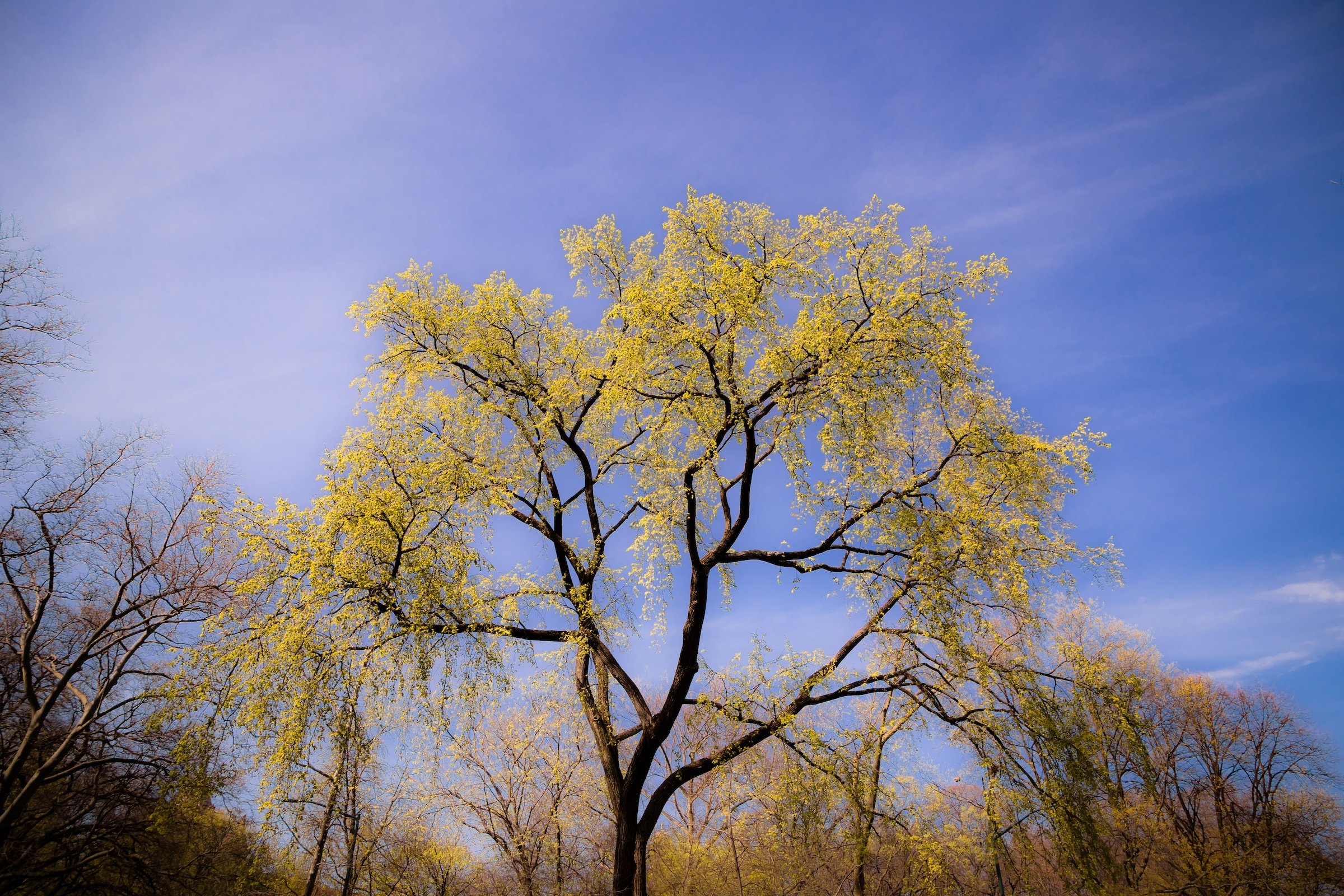
Its visual language also changes dramatically with the seasons. Winter exposes branches, stone, and skyline; spring briefly turns the Park into blossom and color; summer fills its lawns and paths with activity; autumn intensifies the drama of canopy, water, and light. Central Park is designed to be revisited, and its identity is never fixed for long.