
THE DAIRY
Location
Geographic Setting
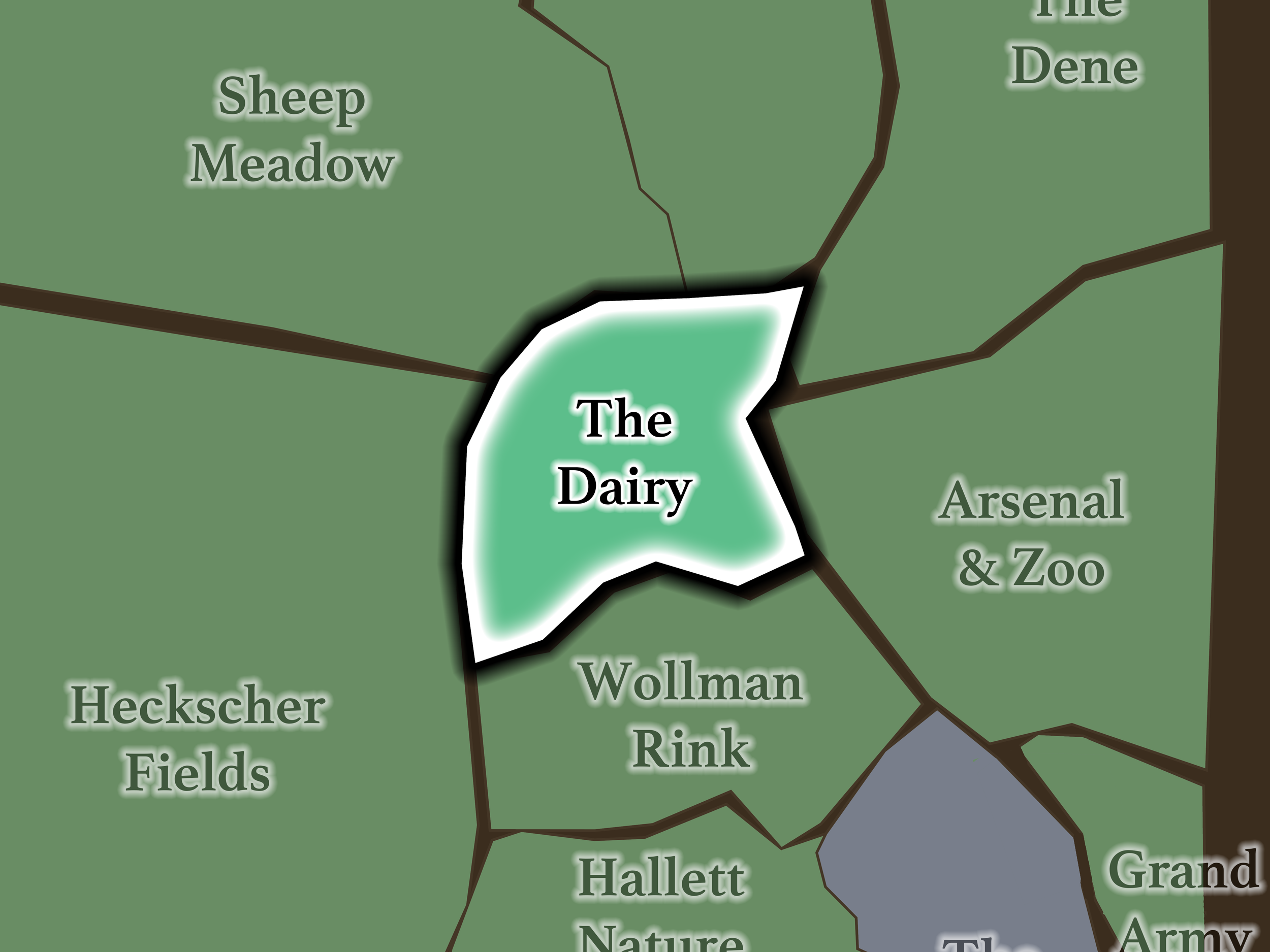
The Dairy occupies a varied landscape near the center of the South End. Heckscher Fields lie across Center Drive to the west; Sheep Meadow and The Mall begin beyond Center Drive to the north; The Dene and Central Park Zoo & Arsenal lie across East Drive; and Wollman Rink sits immediately to the south.
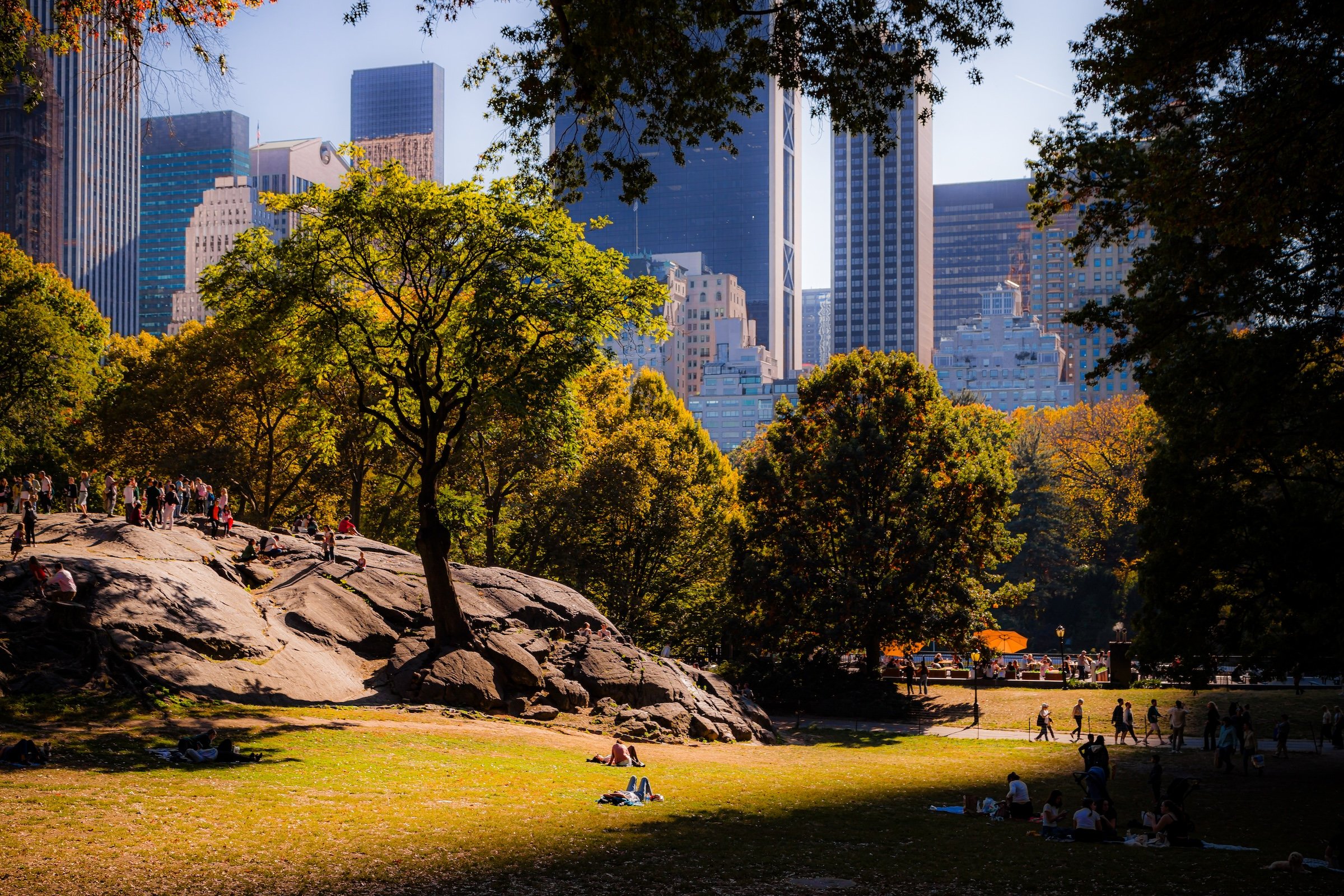
Although the Victorian cottage provides the neighborhood’s obvious architectural focus, the surrounding terrain is equally important. The ground rises toward Cat Rock and the former Kinderberg, creating a sloping lawn and rocky upper landscape above the Dairy itself. Playmates Arch and Driprock Arch then connect this district into the larger circulation system of the South End.
Etymology
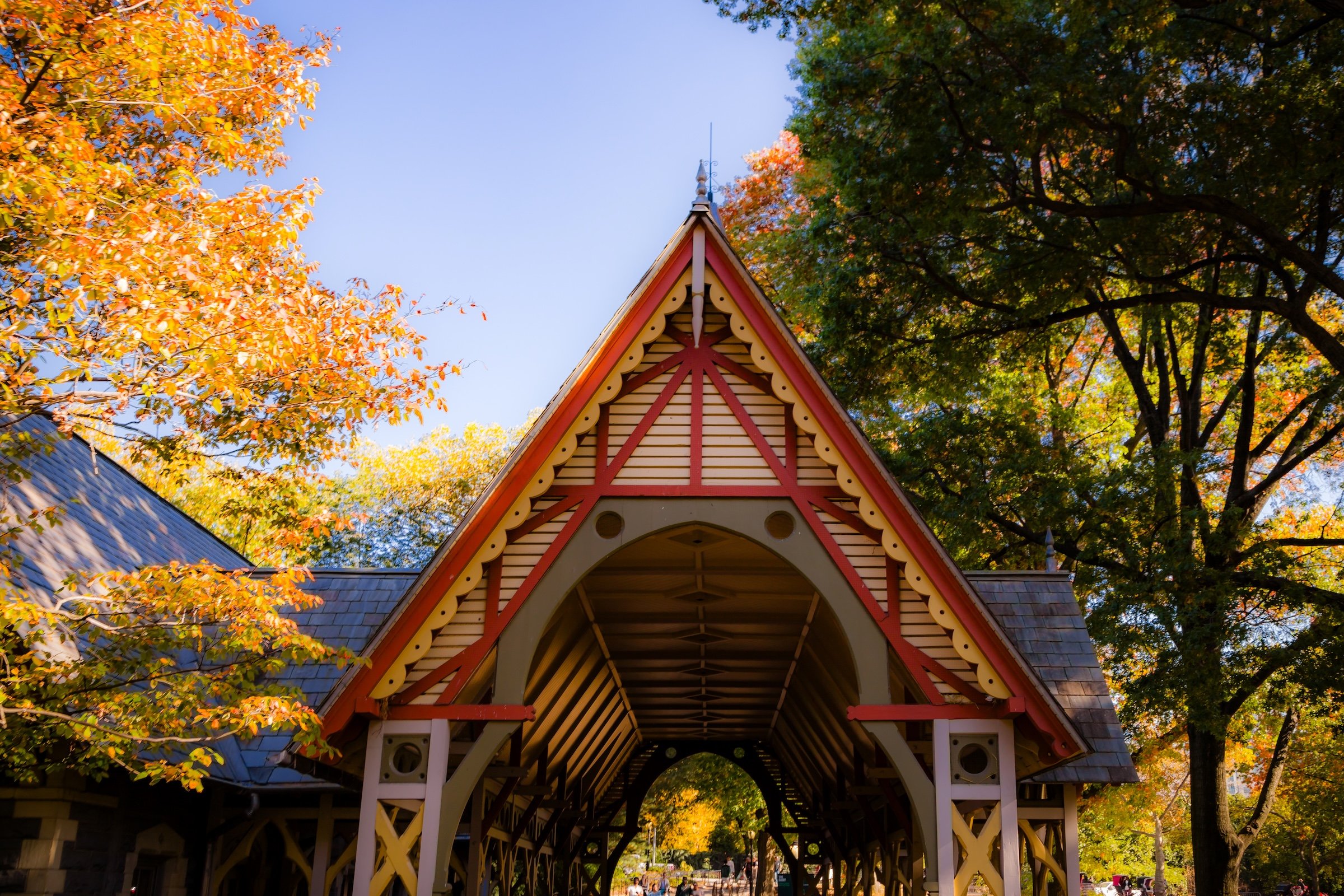
The Dairy takes its name directly from the purpose of Calvert Vaux’s Victorian cottage, completed in 1871 as a place where children and their caregivers could obtain fresh milk, snacks and other refreshments. At a time when reliable fresh milk was not readily available to many urban families, the Dairy made nourishment part of Central Park’s larger promise of health, recreation and escape from the city.
History
1858–1873: Greensward Plan & Construction
The Dairy tells an interesting story about how Central Park’s design evolved almost immediately after the Greensward Plan was chosen. The original plan did not provide a dedicated district for children, and newspapers soon criticized the omission—particularly the lack of facilities for working-class children and their caregivers. Olmsted and Vaux responded by developing the Children’s District near 65th Street, easily reached from public transportation at the southern edge of the park.
The resulting landscape included the Dairy, Playmates Arch, the Ball Ground, Carousel, a children’s cottage and the Kinderberg—a large rustic summerhouse perched on the rocky high ground now occupied by Chess & Checkers House. Rather than a single playground, the Children’s District became an entire landscape devoted to families, with architecture, lawn, rock, recreation and refreshments working together.
1858–1899: Early History & Grand Openings
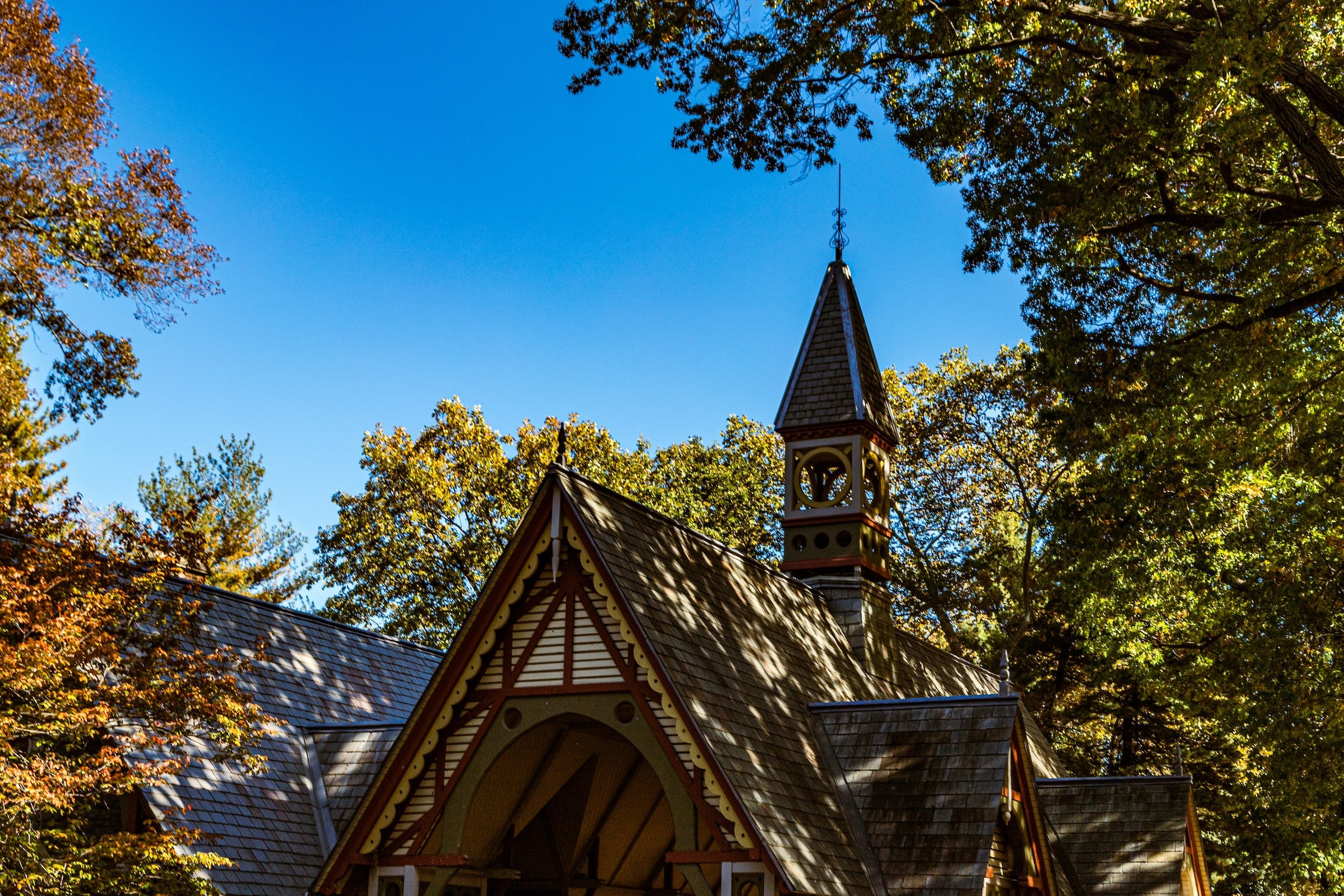
The Kinderberg appeared first, in 1866, followed by the Dairy, constructed between 1869 and 1871. Vaux designed the Dairy as a picturesque Victorian country cottage with an open-air loggia where families could take refreshments while children played on the broad rolling lawn below. Visitors could also borrow games there for use elsewhere in the Children’s District.
By 1872, the Children’s District was essentially complete. The Dairy served as its architectural and social center, while the rocky Kinderberg above provided shade, tables and a rustic overlook. Together they made this part of Central Park one of the earliest deliberately child-centered public landscapes in New York.
20th Century: Transformation & Restoration
The district’s original structures did not all survive. The Kinderberg deteriorated and was removed by the early 1950s, replaced in 1952 by the brick Chess & Checkers House. The Dairy also fell into disrepair, and its elaborate open-air loggia was removed during the middle of the century.
In 1979, the Dairy became Central Park’s first visitor center. Soon afterward it became one of the fledgling Central Park Conservancy’s earliest major restoration projects, with the historic loggia reconstructed in the early 1980s. The Chess & Checkers House was refurbished during the same general revival of the Children’s District.
Explore
21st Century: Renovation & Modernization
Today, The Dairy remains dominated by its storybook Victorian cottage, but the neighborhood becomes more interesting when experienced as a landscape rather than a building.
The lawn rises behind and around the Dairy toward substantial outcrops of Manhattan schist, including Cat Rock and the elevated site of Chess & Checkers House. Paths climb between them while Playmates Arch and Driprock Arch carry the drives above pedestrian routes, producing the sort of above-and-below circulation that characterizes Central Park at its best. Cat Rock itself has also become one of the park’s established bouldering locations.
The Dairy was comprehensively restored again in 2021 and continues as a visitor center and gift shop. In 2023, the Conservancy completed restoration of Chess & Checkers House and the surrounding Kinderberg landscape, including a new rustic shelter that deliberately recalls the nineteenth-century structure once found there.
Waypoints
-
A substantial schist outcrop rising above the Dairy landscape, Cat Rock provides both an elevated physical presence within the neighborhood and one of Central Park’s recognized bouldering locations.
-
Built in 1952 on the former site of the Kinderberg, this octagonal game pavilion is surrounded by outdoor chess tables and a restored rustic shelter recalling the nineteenth-century Children’s District.
-
Calvert Vaux’s 1871 Victorian cottage originally supplied fresh milk and refreshments to children and caregivers. Today it serves as a visitor center and Central Park’s largest gift shop.
-
Named for the massive nearby rock outcrop, Driprock carries carriage traffic above the pedestrian connection between Wollman Rink and Heckscher Fields, contributing another layer to the neighborhood’s intricate circulation system.
-
Named for its place within the Children’s District, this colorful brick arch carries the drive above the pedestrian route between the Dairy and Chess & Checkers House on one side and the Carousel and Heckscher Fields on the other.
Photography
Visual Identity
Central Park has no single visual identity. It moves between open meadow and enclosed woodland, exposed bedrock and carefully planted garden, reflective water and hard-edged skyline. Its paths can narrow into shade beneath old trees, then open suddenly toward towers, lakes, monuments, or a broad field filled with people. The Park’s character is made from those transitions: the designed discovery of one landscape giving way to another.
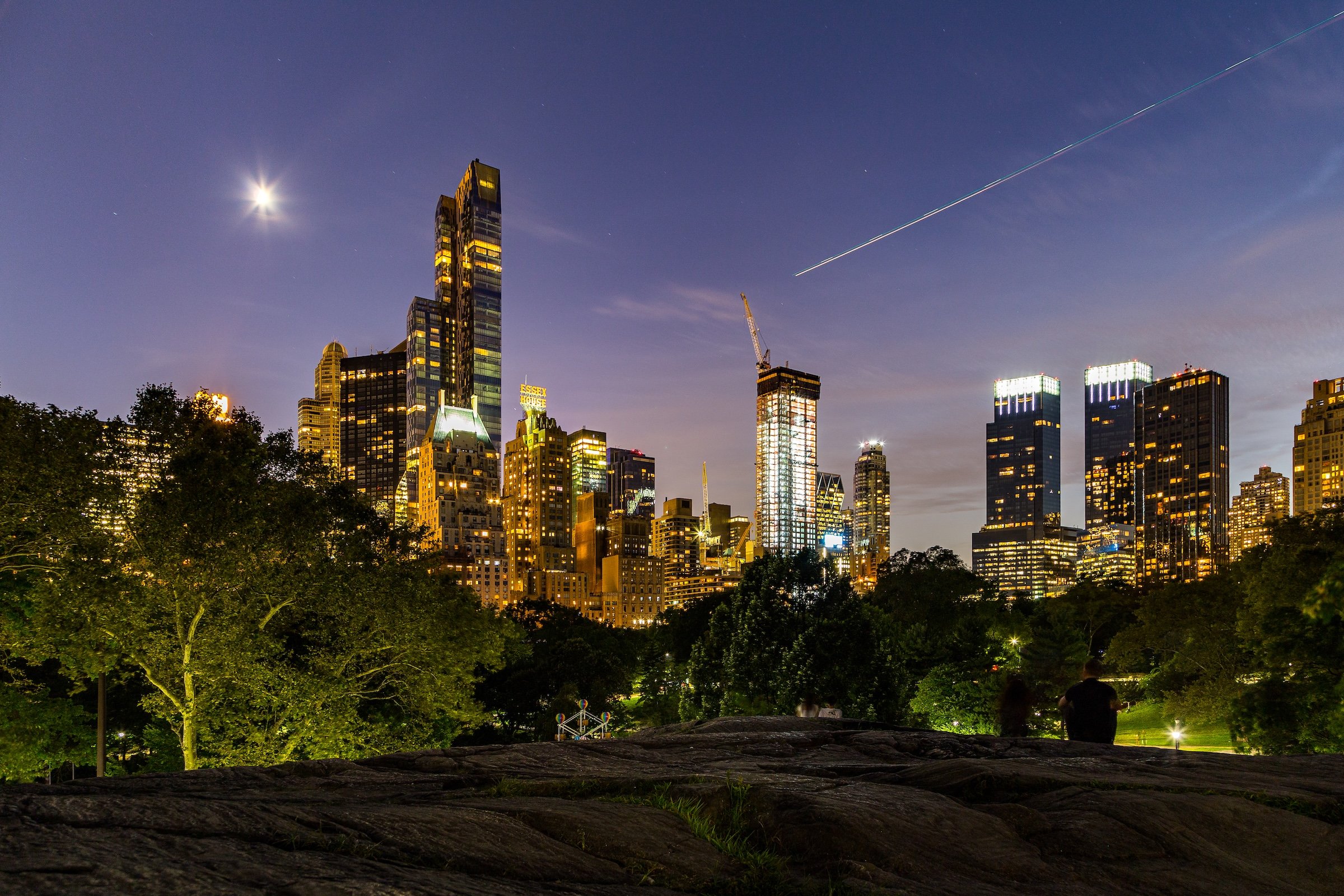
Water and horizon recur throughout its geography. The Lake, Reservoir, ponds, fountains, and seasonal pools of light create places of reflection—sometimes literal, sometimes figurative—where the city appears fractured, softened, or enlarged. Beyond them, Manhattan’s towers remain present as a constant reminder that this cultivated landscape exists within, not apart from, one of the world’s densest cities.
Its visual language also changes dramatically with the seasons. Winter exposes branches, stone, and skyline; spring briefly turns the Park into blossom and color; summer fills its lawns and paths with activity; autumn intensifies the drama of canopy, water, and light. Central Park is designed to be revisited, and its identity is never fixed for long.