
ROLLING MEADOWS
Location
Geographic Setting
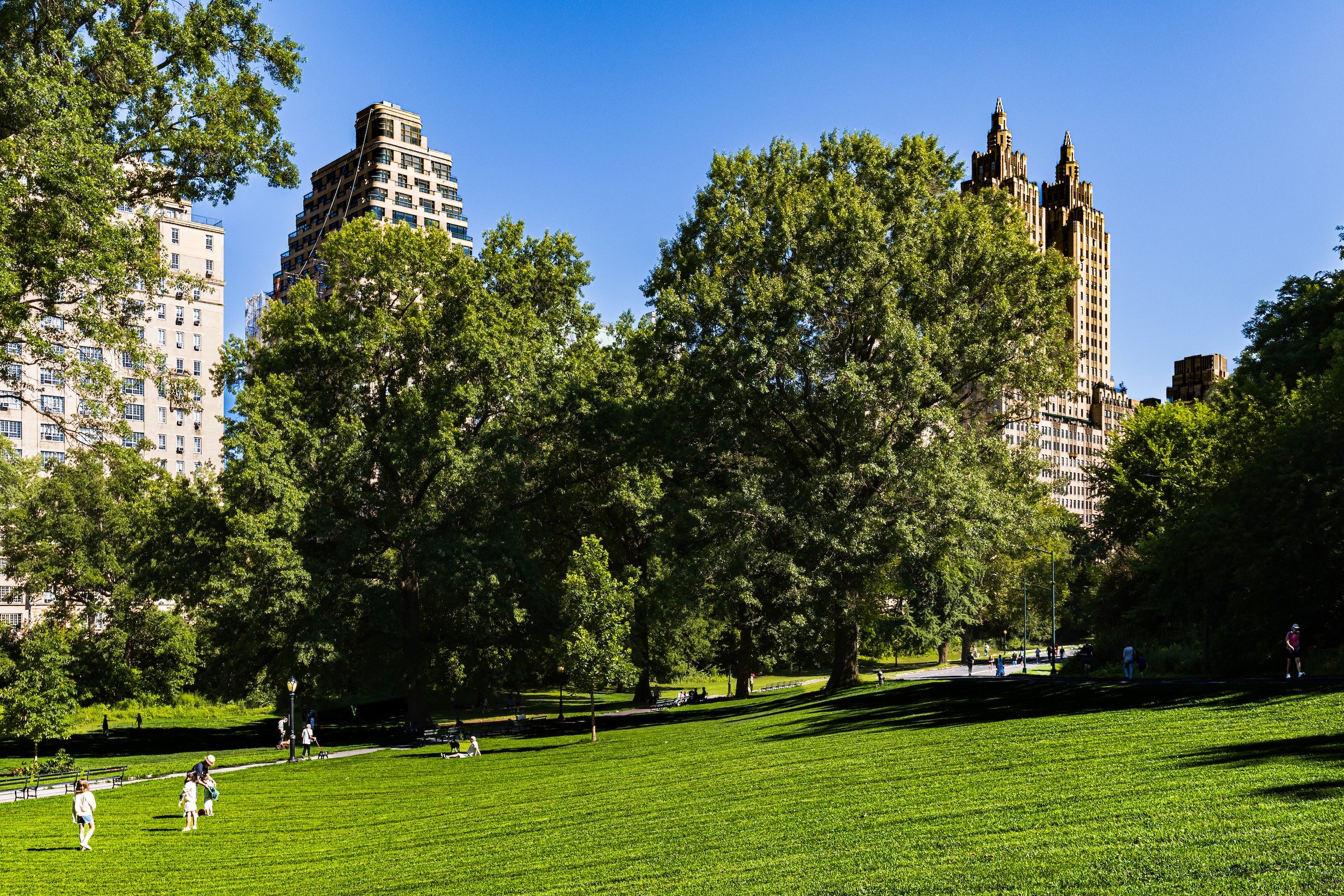
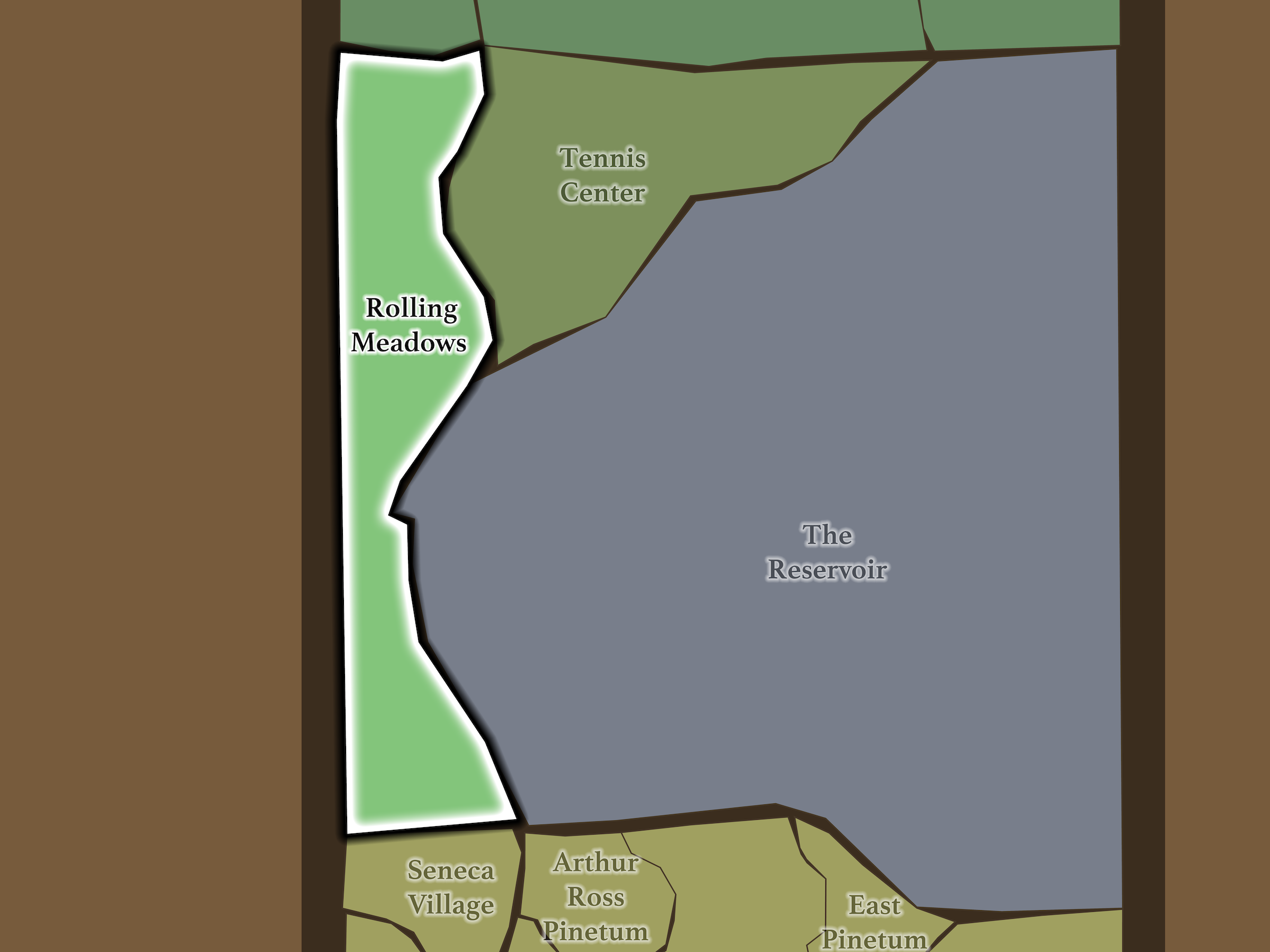
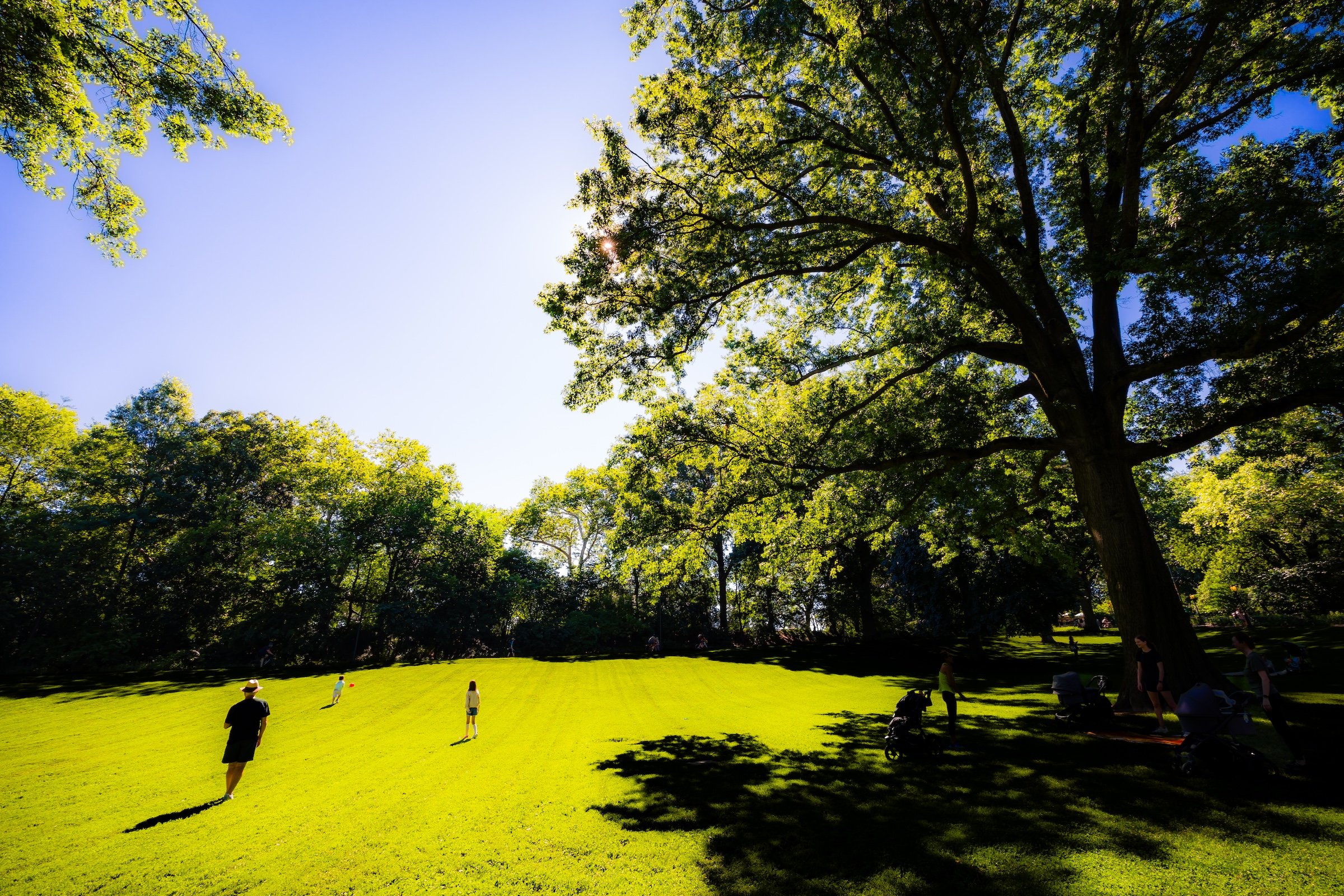
Rolling Meadows forms a long, slender strip along the western edge of Mid-Park North. Seneca Village ends at the 86th Street Transverse to the south; The Reservoir and Tennis Courts lie across West Drive to the east; and Central Park West places the Upper West Side immediately beyond the park boundary.
Its narrowness is deceptive. The land repeatedly widens into grassy slopes large enough for picnicking, play and family gatherings before contracting again around paths, playgrounds and entrances. The rolling topography also creates changing relationships with the city: apartment buildings loom above the western tree line while occasional openings eastward reveal the Reservoir.
Etymology
Rolling Meadows is a CityNeighborhoods designation for the narrow western greensward running north alongside the Reservoir. The name grows directly from the character of the landscape itself: lawns rising and falling beneath mature trees between Central Park West and West Drive.
There is also unusually strong precedent for that language. The Central Park Conservancy formally identifies the southern portion as the West 86th–90th Street Landscape, describing it as a small meadow with “rolling lawns and large trees” and, following its 2017 restoration, as an “open, rolling greensward.” Rolling Meadows extends that existing landscape idea northward through the similarly shaped western band.
History
1858–1873: Greensward Plan & Construction
This western landscape developed alongside one of the largest engineering projects undertaken during Central Park’s creation: the new Reservoir.
Unlike the old Croton Receiving Reservoir farther south, the Reservoir between 86th and 96th Streets was constructed as Central Park itself was being built. Olmsted and Vaux incorporated the enormous waterworks into their larger landscape by surrounding it with circulation routes and planted terrain rather than allowing its masonry walls to stand in isolation.
Along its western side, carriage roads, pedestrian paths and the Bridle Path negotiated a naturally uneven strip between the Reservoir and the park boundary. The resulting landscape was never one enormous meadow. Instead, it became a succession of slopes, lawns, trees and pathways—the basic rhythm that still defines Rolling Meadows.
1858–1899: Early History & Grand Openings
When the Reservoir began operating in 1862, this western edge became both a circulation corridor and an approach to one of Central Park’s great engineered vistas. Visitors could travel beside the water while moving through terrain that rose and fell independently of the Reservoir’s rigid geometry.
The contrast is fundamental to the landscape: the Reservoir is monumental, geometric and almost perfectly level, while the land immediately west of it is irregular, shaded and rolling.
The park’s nineteenth-century entrance system also gave this edge an important connection to the surrounding city. The entrance at West 96th Street was named the Gate of All Saints, one of the original occupational and civic gate names intended to represent the people of New York rather than individual dignitaries.
20th Century: Transformation & Restoration
The western perimeter changed significantly during the 1930s as active recreation was added throughout Central Park. Playgrounds appeared along this edge, including the predecessors of today’s Safari, Wild West and Rudin Family Playgrounds. The original Safari Playground site dates to 1936, while Rudin Family Playground was constructed in 1935 as part of the Robert Moses-era playground program.
Later generations transformed these conventional playgrounds into much more distinctive spaces. Architect Richard Dattner redesigned what became Wild West Playground in 1988, while Safari Playground acquired its famous hippopotamus theme in 1997.
By the early twenty-first century, intensive use and inadequate drainage had badly eroded portions of the surrounding lawns. The Conservancy’s 2017 restoration of the West 86th–90th Street landscape rebuilt drainage and irrigation, restored paths and plantings, improved accessibility and deliberately returned the area to an open rolling greensward.
Explore
21st Century: Renovation & Modernization
Rolling Meadows is one of those Central Park landscapes whose scale changes while you are inside it.
On a map, it looks almost too thin to constitute a place of its own. On foot, the repeated slopes and openings create surprisingly generous spaces—lawns for picnics, family gatherings or simply sitting beneath the trees, connected by paths that continue north and south along the park edge.
The Upper West Side is unusually present here. Apartment buildings rise immediately beyond the canopy, reinforcing the sense that this is a neighborhood-facing landscape—less monumental than the Reservoir beside it, but deeply useful to the people who enter the park from the surrounding streets.
The contrast with the Reservoir also gives the area much of its character. To the east is an immense horizontal plane of water; to the west, city architecture. Rolling Meadows occupies the soft middle ground: trees, slopes, playgrounds and grass continually rising and falling between the two.
Its playgrounds have increasingly been designed to participate in that landscape rather than stand apart from it. Recent Conservancy reconstruction projects have lowered fences, restored surrounding planting and improved physical connections between play spaces and parkland—an approach explicitly intended to treat playgrounds as parts of Central Park rather than isolated recreational enclosures.
Waypoints
-
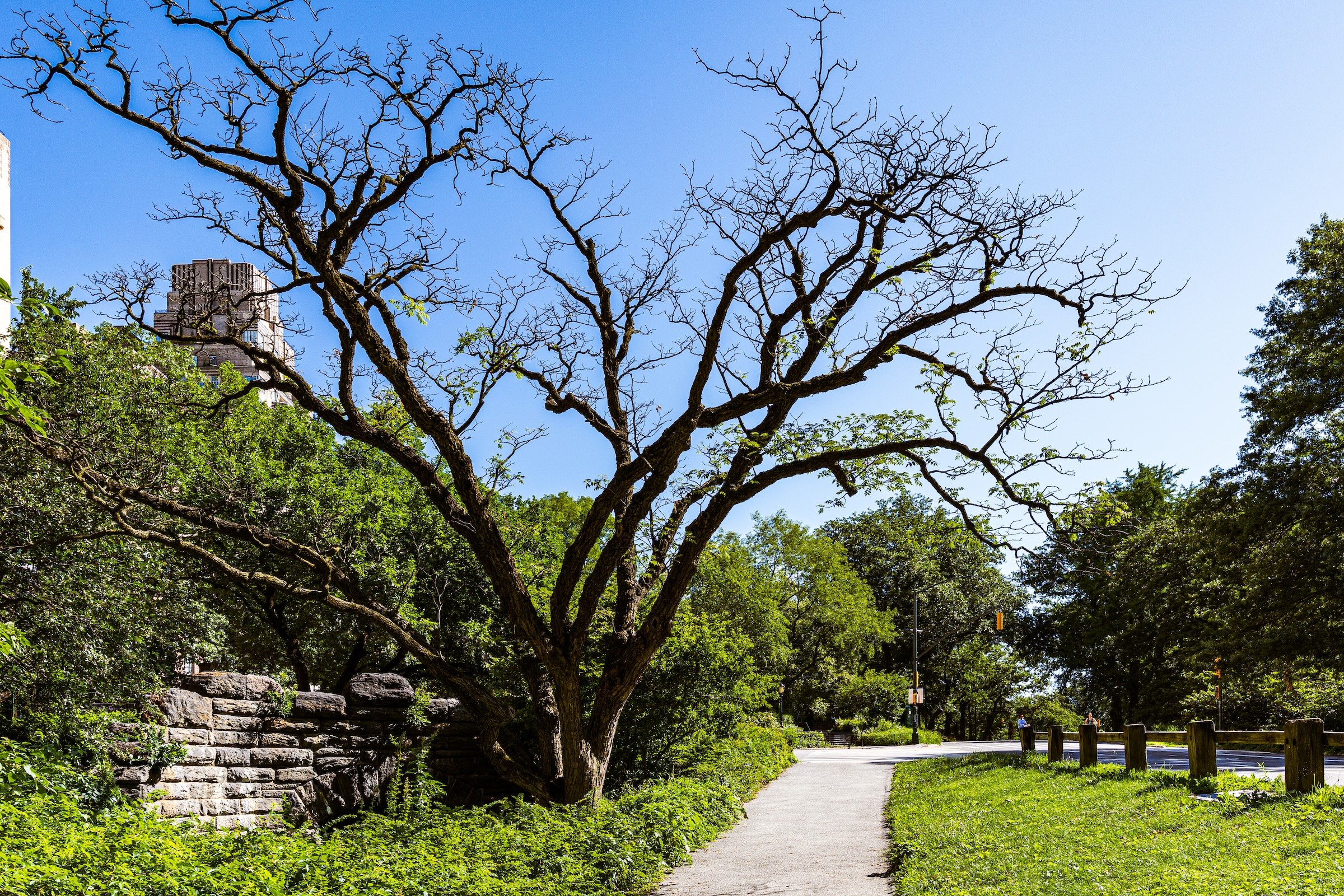
This rustic stone crossing is embedded into the western landscape near 90th Street, allowing one circulation route to pass beneath another while largely disappearing into the surrounding terrain. It is another small expression of Central Park’s three-dimensional movement system.
-
The historic entrance at West 96th Street belongs to Central Park’s original system of named gates. Its location makes it one of Rolling Meadows’ principal connections with the Upper West Side.
-
Located at West 96th Street, this neighborhood-oriented playground is known for its wisteria-covered trellis, swings, climbing structures, water play and picnic/game tables. A new comprehensive reconstruction is currently in design, with particular emphasis on accessibility and strengthening its relationship to the surrounding landscape.
-
Better known to generations of children as the Hippo Playground, Safari features climbable hippopotamus sculptures arranged around a stylized river. Its 2019 reconstruction preserved that identity while adding new play mounds, canoes, water features and improved accessibility; its elevated position also provides sweeping Reservoir views.
-
Richard Dattner’s 1988 playground evokes a Western frontier town through timber towers, walls and imaginative play structures. The Conservancy completely rebuilt it in 2015 while retaining Dattner’s unusual theme and basic spatial concept.
Photography
Visual Identity
Central Park has no single visual identity. It moves between open meadow and enclosed woodland, exposed bedrock and carefully planted garden, reflective water and hard-edged skyline. Its paths can narrow into shade beneath old trees, then open suddenly toward towers, lakes, monuments, or a broad field filled with people. The Park’s character is made from those transitions: the designed discovery of one landscape giving way to another.
Water and horizon recur throughout its geography. The Lake, Reservoir, ponds, fountains, and seasonal pools of light create places of reflection—sometimes literal, sometimes figurative—where the city appears fractured, softened, or enlarged. Beyond them, Manhattan’s towers remain present as a constant reminder that this cultivated landscape exists within, not apart from, one of the world’s densest cities.
Its visual language also changes dramatically with the seasons. Winter exposes branches, stone, and skyline; spring briefly turns the Park into blossom and color; summer fills its lawns and paths with activity; autumn intensifies the drama of canopy, water, and light. Central Park is designed to be revisited, and its identity is never fixed for long.