
TENNIS CENTER

Location
Geographic Setting
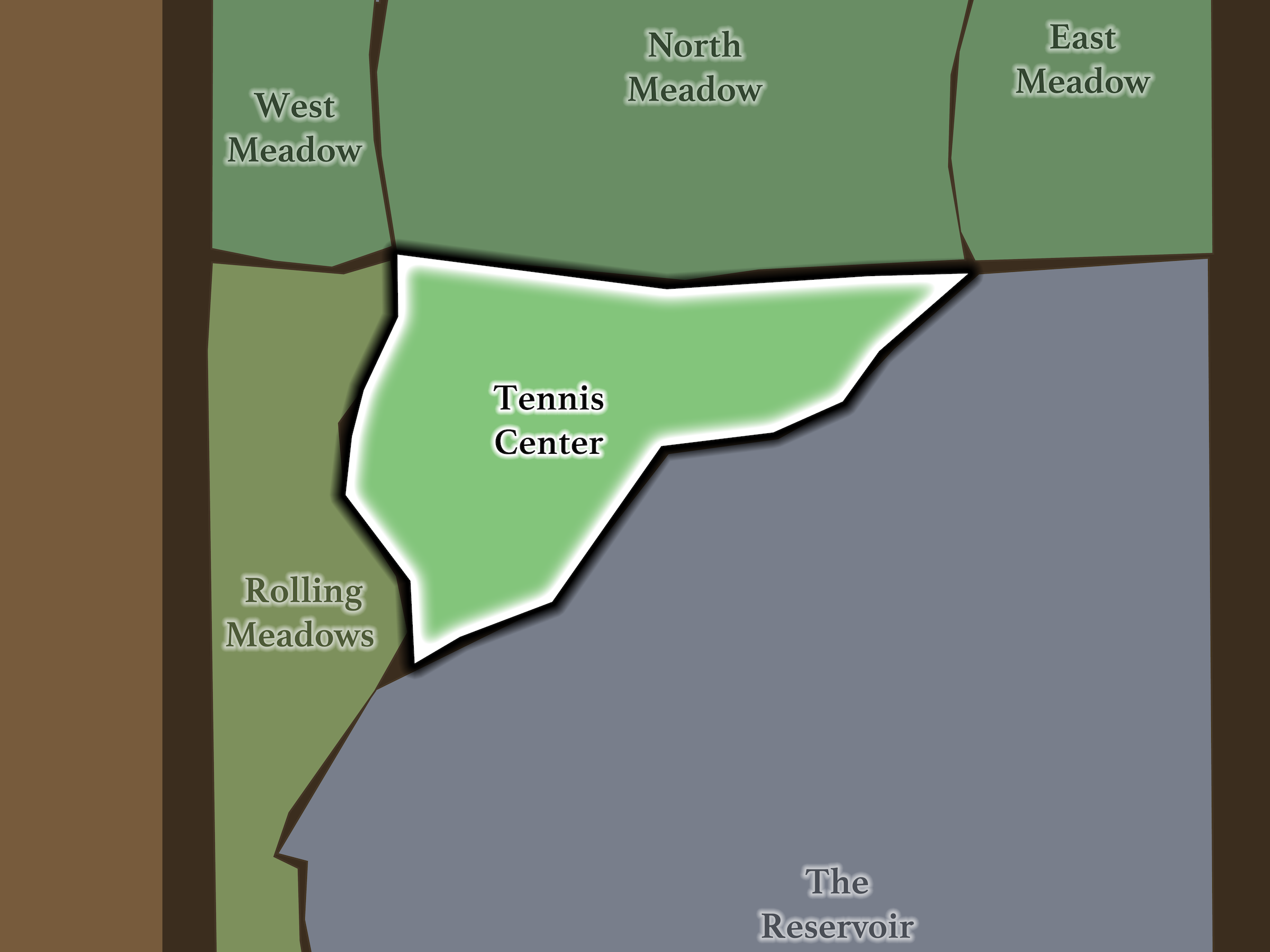
The Tennis Center occupies a surprisingly secluded landscape between approximately West 94th and 96th Streets. The Reservoir lies immediately south beyond the Bridle Path; Rolling Meadows rises across West Drive to the west; and North Meadow begins beyond the 97th Street Transverse in the North End.
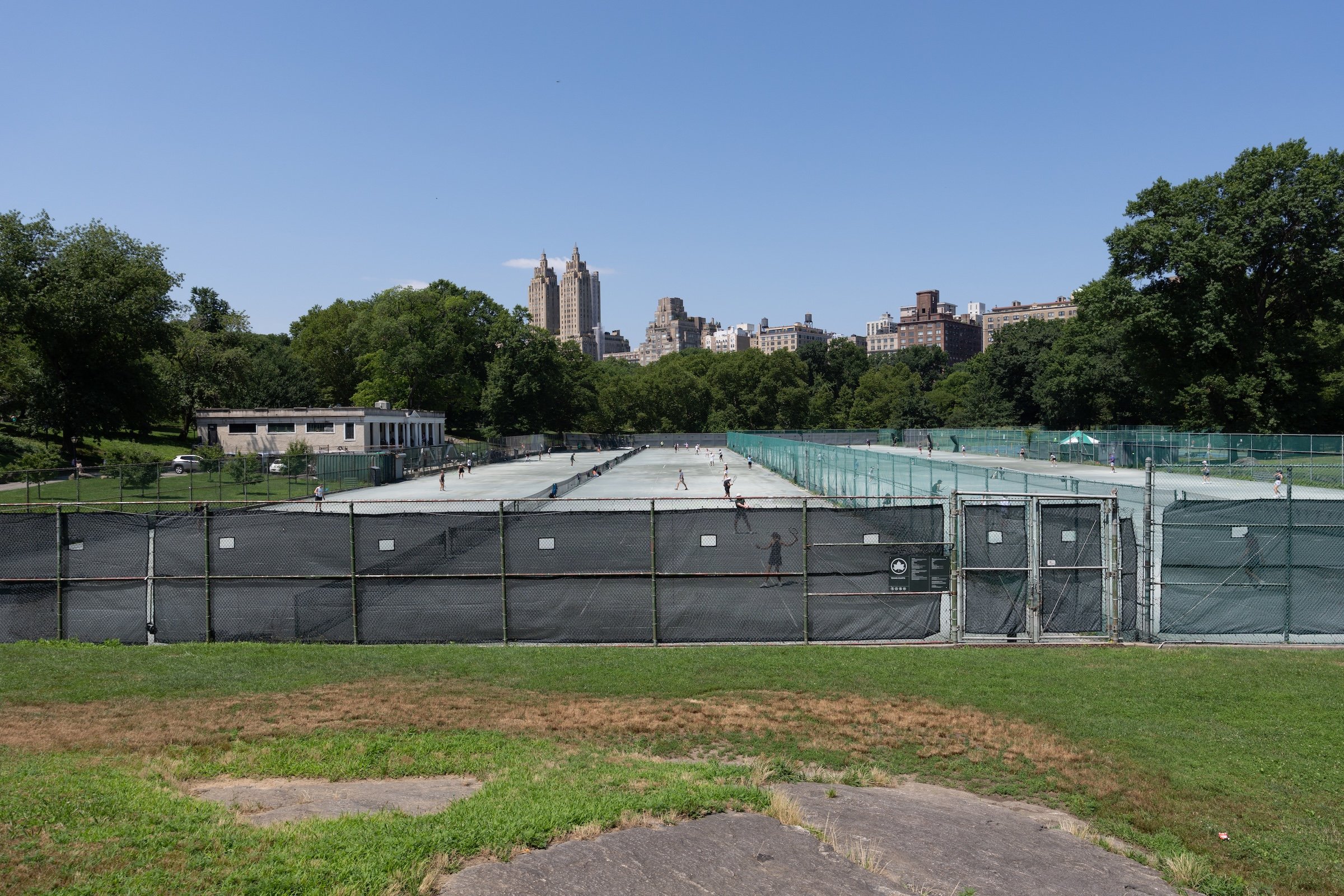
Its topography helps disguise its considerable size. Thirty courts occupy a relatively low basin surrounded by mature trees, rocky slopes and higher ground. From many nearby paths, little of the complex can be seen. Only after descending toward the courts does the scale of the facility become apparent.
That hidden quality distinguishes it from Central Park’s other major recreational landscapes. The Great Lawn and North Meadow announce themselves through openness; the Tennis Center is something you largely have to go looking for.
Etymology
Tennis Center takes its name from the large public tennis complex occupying this sheltered landscape north of the Reservoir. Tennis has been played here since the 1880s, initially with temporary nets erected on existing lawns. Permanent courts were established in 1910, gradually turning what had been meadow into one of Central Park’s principal centers for active recreation.
Today, with 26 clay courts and four hard courts, the Central Park Tennis Center is the largest collection of public tennis courts in New York City.
History
1858–1873: Greensward Plan & Construction
Olmsted and Vaux did not originally design this landscape as a permanent tennis complex. Their Central Park favored scenic walks, carriage rides, equestrian routes and comparatively informal recreation, with open meadows generally preserved for flexible use rather than dedicated athletic infrastructure.
Tennis nonetheless arrived in Central Park relatively early. By the 1880s, temporary courts were being created in this meadow north of the Reservoir by erecting nets and marking playing areas on the grass. The arrangement allowed the landscape to continue functioning as meadow when tennis was not being played.
The evolution of this site therefore reflects an important change in Central Park itself: growing demand for organized recreation gradually transformed portions of Olmsted and Vaux’s flexible open spaces into permanent athletic facilities.
1858–1899: Early History & Grand Openings
During Central Park’s nineteenth-century decades, this remained primarily meadowland rather than a formally constructed sports complex. Tennis was played here, but the courts were temporary and the landscape retained much of its original open character.
The sport’s rapidly increasing popularity eventually made that arrangement impractical. By the beginning of the twentieth century, tennis had become an established Central Park activity, and in 1910 permanent courts were constructed on the meadow.
This marked the beginning of the landscape visitors recognize today: recreation was no longer simply happening on the meadow—the meadow itself was being redesigned around recreation.
20th Century: Transformation & Restoration
The Tennis Center expanded rapidly. By 1927, the facility had reached its present total of 30 courts, arranged in three long rows. Growing use also created demand for changing rooms, lockers and showers, leading to construction of the Tennis House in 1930.
The Tennis House was significant beyond the sport itself. It was the first completely new building erected in Central Park during the twentieth century, marking a broader shift toward permanent recreational facilities throughout the park.
That transformation accelerated elsewhere during the century as ballfields, playgrounds, courts and other active-recreation facilities became increasingly important parts of Central Park. The Tennis Center stands among the earliest and clearest examples of that evolution.
Explore
21st Century: Renovation & Modernization
Today, Tennis Center is one of Central Park’s busiest recreational destinations while remaining curiously easy to overlook.
The complex contains 26 Har-Tru clay courts and four hard courts, oriented north–south in three rows, with the historic Tennis House forming the southern edge. Courts operate seasonally, generally from early April until shortly before Thanksgiving, and public play requires an NYC Parks tennis permit.
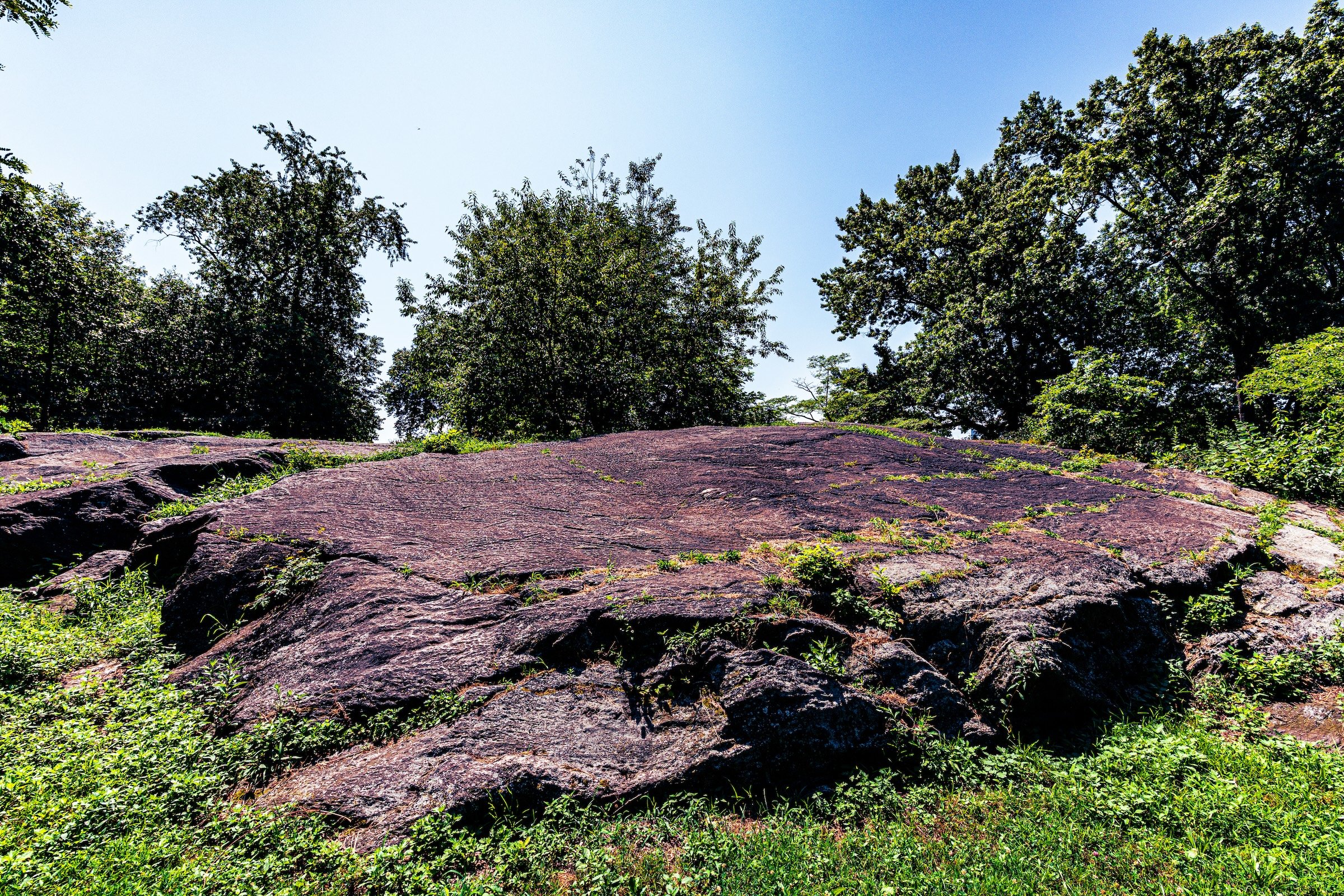
Yet the experience is surprisingly intimate for a facility containing thirty courts. Tall trees and rocky ground rise around the perimeter, muting both the visual and psychological presence of the surrounding city. Even the nearby Reservoir largely disappears behind vegetation and changes in elevation.
That enclosure gives the Tennis Center a character very different from the Great Lawn or North Meadow. Those spaces place recreation on broad public display. Here, an enormous civic sporting facility has been tucked almost invisibly into the landscape.
It is another example of Central Park’s ability to absorb surprisingly large pieces of infrastructure without allowing them to overwhelm the park around them.
Waypoints
-
Established with permanent courts in 1910 and expanded to its present 30-court configuration by 1927, the Tennis Center is New York City’s largest complex of public tennis courts. Its 1930 Tennis House provides the architectural focus for a facility otherwise largely concealed by the surrounding terrain and trees
Photography
Visual Identity
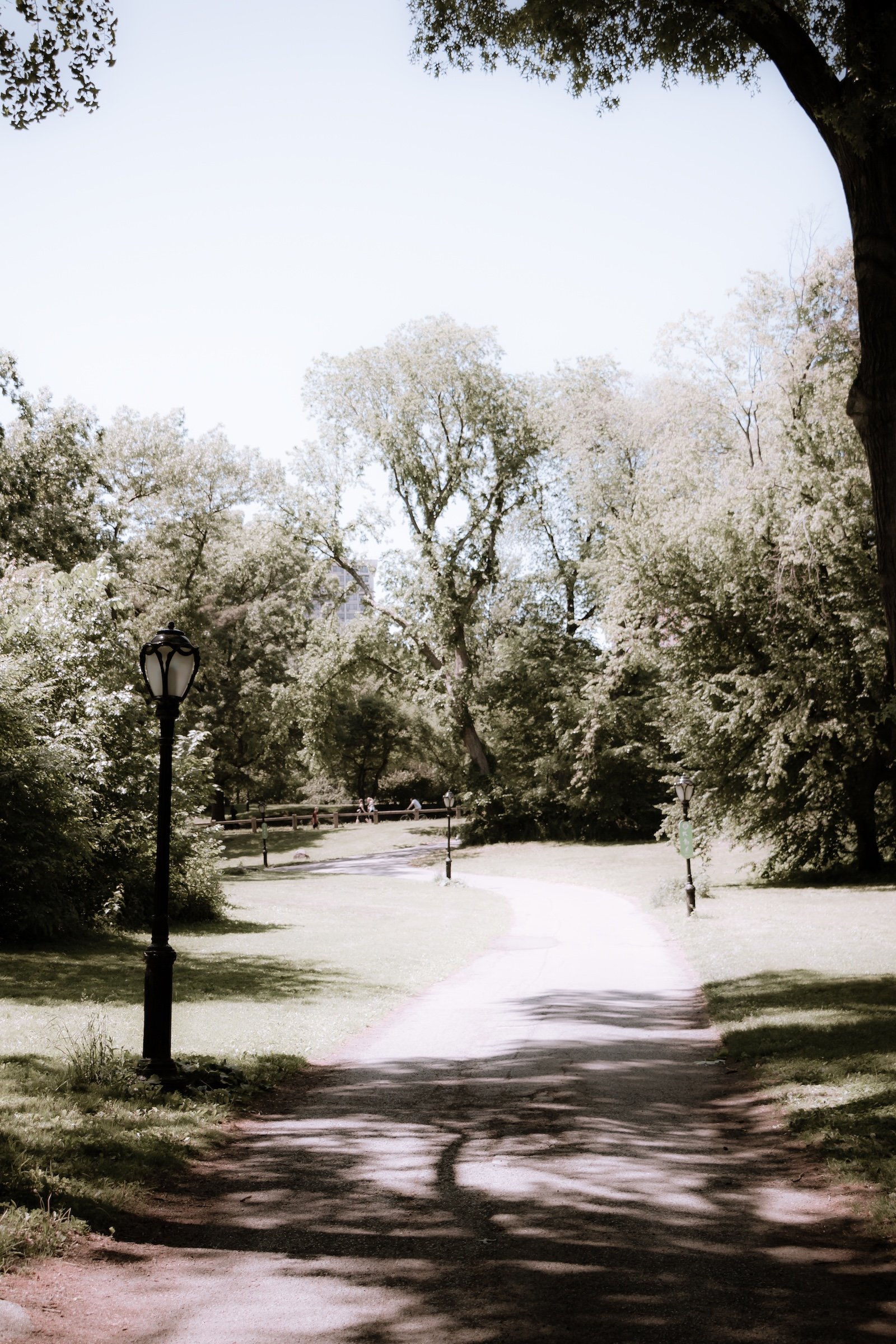
Central Park has no single visual identity. It moves between open meadow and enclosed woodland, exposed bedrock and carefully planted garden, reflective water and hard-edged skyline. Its paths can narrow into shade beneath old trees, then open suddenly toward towers, lakes, monuments, or a broad field filled with people. The Park’s character is made from those transitions: the designed discovery of one landscape giving way to another.
Water and horizon recur throughout its geography. The Lake, Reservoir, ponds, fountains, and seasonal pools of light create places of reflection—sometimes literal, sometimes figurative—where the city appears fractured, softened, or enlarged. Beyond them, Manhattan’s towers remain present as a constant reminder that this cultivated landscape exists within, not apart from, one of the world’s densest cities.
Its visual language also changes dramatically with the seasons. Winter exposes branches, stone, and skyline; spring briefly turns the Park into blossom and color; summer fills its lawns and paths with activity; autumn intensifies the drama of canopy, water, and light. Central Park is designed to be revisited, and its identity is never fixed for long.